Finding My Way Back Through Rome’s Markets

For years, this blog sat quietly in a forgotten corner of the internet.

It wasn’t because I stopped traveling. Quite the opposite. My work and personal life carried me across countries and continents at a pace that left little room for reflection. There were stories everywhere, yet somewhere along the way, I stopped writing them down.

Now, as my life shifts again, I have found myself revisiting old photographs. Again and again, my thoughts drift back to the months I spent living in Rome. Not to the Colosseum or the Vatican. Instead, my mind returns to two distinct markets. One taught me about Italy; the other reminded me of the wider world. And between them, they helped a foreign city feel like home.

Hera picked me up from Fiumicino Airport.
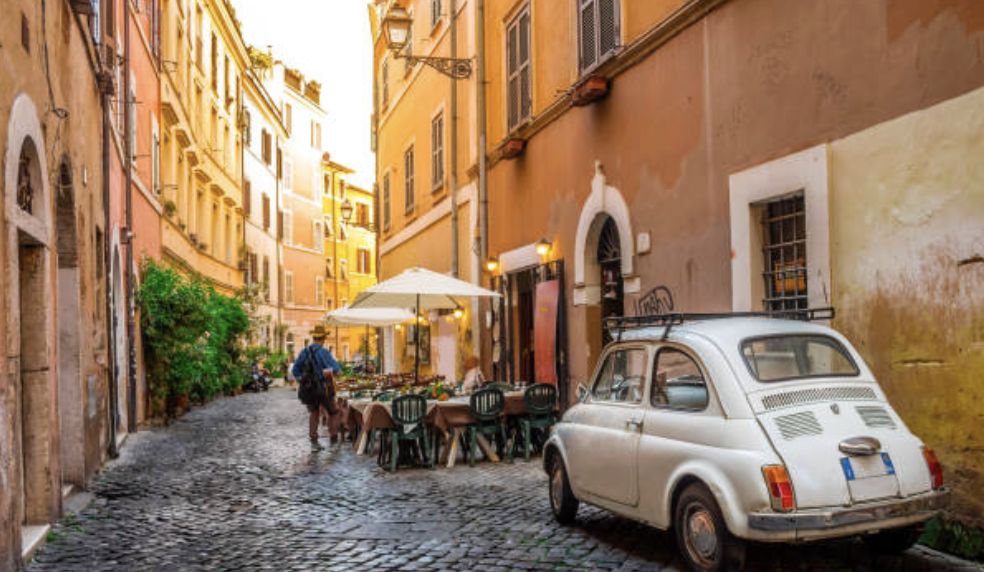
We had worked together years earlier in Montreal. Now living in Rome, we had seen each other the year before after not crossing paths for over a decade. Neither of us expected that we would soon be living in the same city.

Then one day, I sent her a message: “Guess what? I’m moving to Rome.”

For the second time in our lives, we found ourselves sharing a city.

This is what happens, I think, when you spend much of your life away from the place you were born. Those of us who leave our homelands somehow pick up quickly where we left of. We build friendships across continents, lose sight of each other for years, and then unexpectedly reappear in the same place at the same time, sometimes finding more of a community in our transplanted lives than where we permanently reside.

My new home was in Testaccio, Rome.
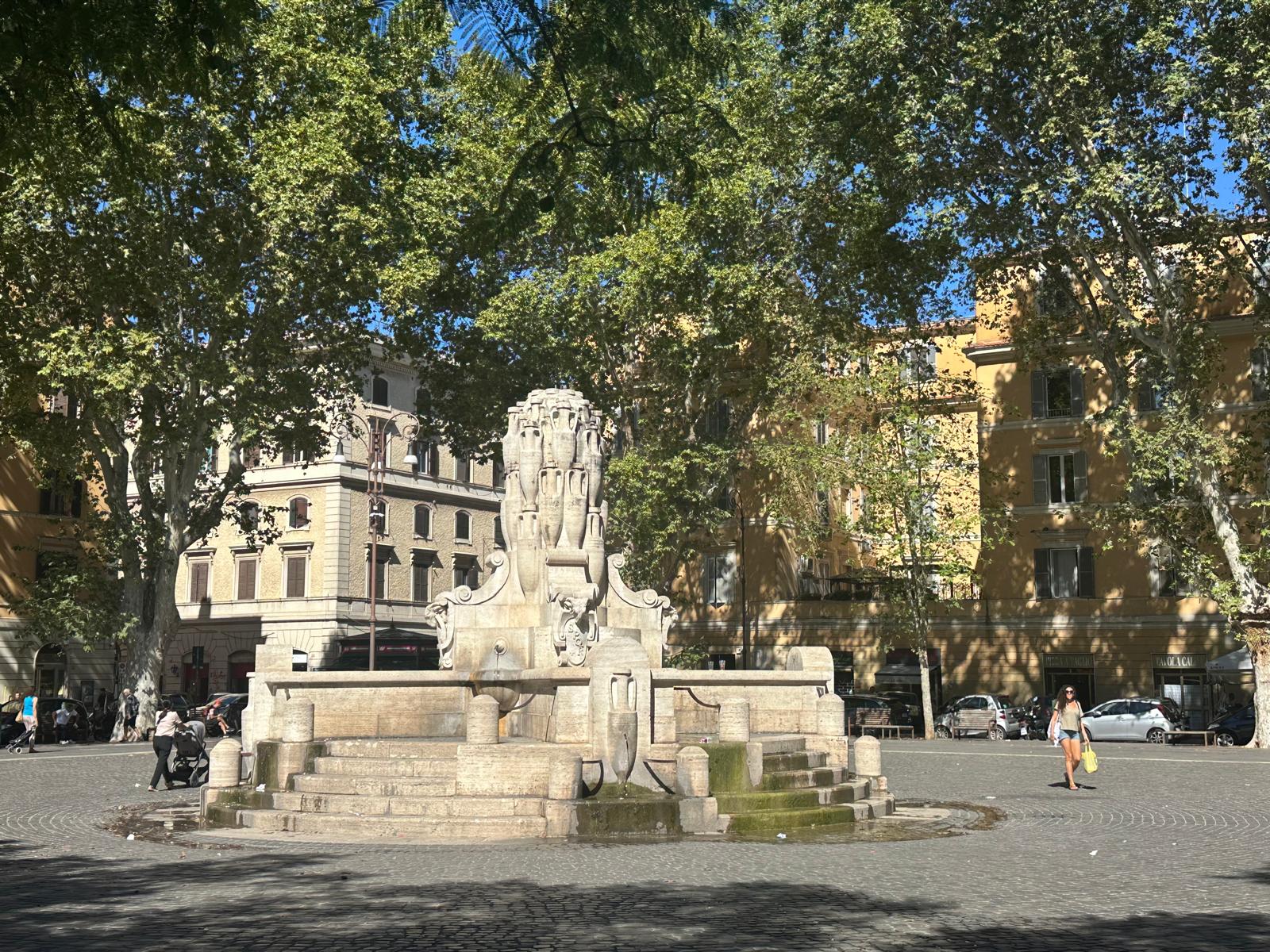
Testaccio is vibrant working neighbourhood just across the Tiber and best known for Monte Testaccio, a hill built from millions of discarded clay amphorae that once carried olive oil throughout the Roman Empire. Yet what captivated me was not its ancient history, but its daily life.

Every evening around five o’clock, the neighbourhood came alive. People of all ages gathered in the square. Teenagers lingered over gelato. Elderly locals sat on benches with their pet dogs exchanging news. Friends and colleagues met up to share pizza, spritz and conversation. It felt like the very embodiment of la dolce vita.

At the heart of it all sat Mercato Testaccio.

On that first day, Hera insisted she take me there so I could familiarize myself with the area. We bought fresh, handmade pasta and sat together in the market square to eat. Before leaving, she insisted I stock my empty kitchen with the essentials: so I chose burrata, prosciutto, good bread, olives, tomatoes, and peaches.
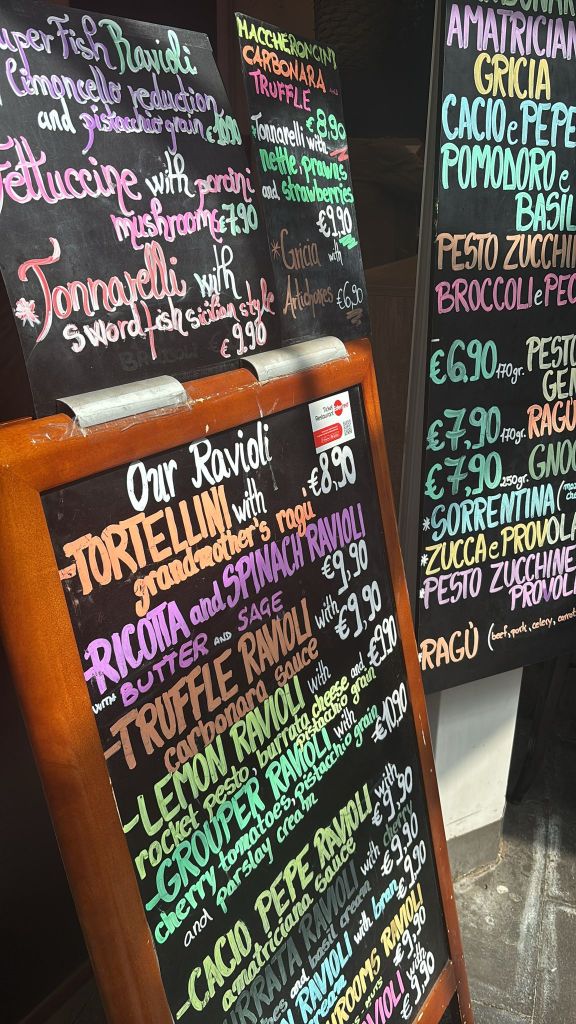
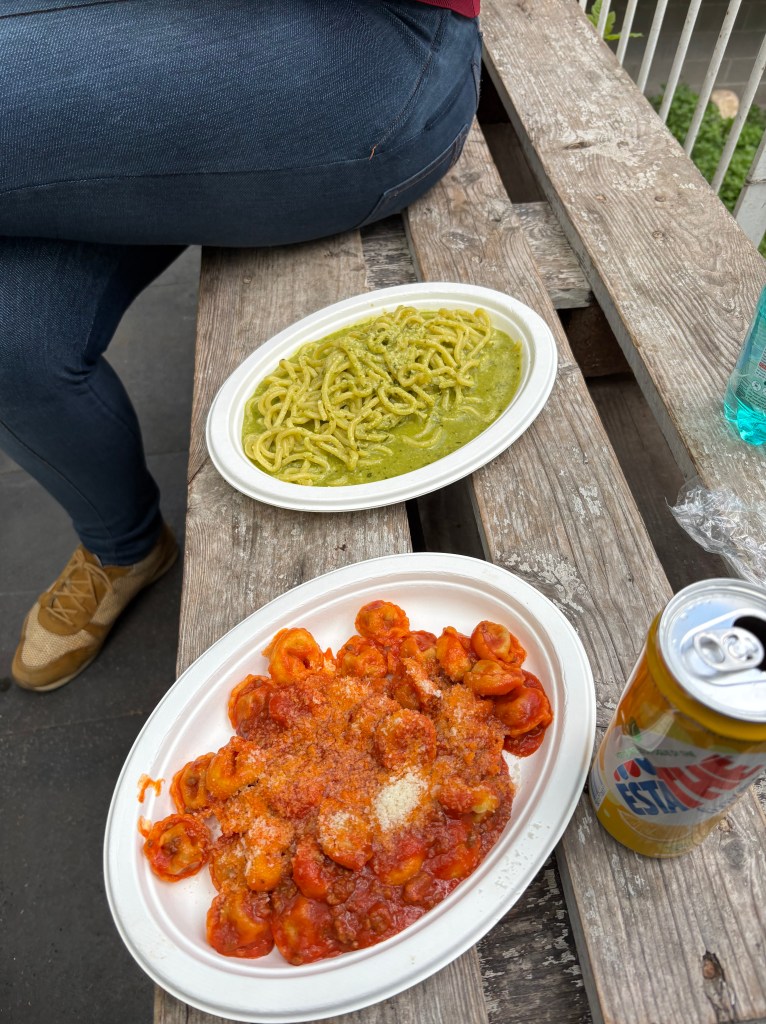
That evening, alone in my apartment, I unpacked my groceries and sat on the floor to eat. I sent a message back to my girfriend’s in Australia, sharing how I felt like the character Julia Roberts played in Eat Pray Love on her very first night – sitting alone on the floor of her apartment, nervous but excited, eating her first meal in the country. The irony was so similar to the choices I had made. My family was thousands of kilometres away, but somehow the market, the food, and an old friend had already made Rome feel a little less foreign.

Every Friday, I worked from home and would take an hour for lunch to wander through the market’s aisles, comparing notes with colleagues who also lived in the neighbourhood. We debated who made the best pizza al taglio, where to find the freshest mortadella, which stall served the best pasta, and where to linger over a leisurely lunch. The market quickly became part of the rhythm of my week and my introduction to everyday Roman life. Like everywhere I have lived, I soon got to know many of the store owners, they would suggest things to try, pop something extra in your bag, and when I had no small change, they would wave a hand and say, prossima volta, next time.

As much as I embraced Roman life, I had grown up in Australia and had resided in Montreal, Canada for many years – two of the world’s most multicultural countries. I was accustomed to markets and supermarket aisles lined with ingredients from every corner of the globe, and neighbourhoods where dozens of cuisines coexisted side by side.

Italy is fiercely proud of its food culture, and rightly so. Yet after a few weeks, I found myself craving spice, exotic vegetables, and the flavours of places far beyond the Mediterranean.

When I wanted Italy, I went to Testaccio. But when I wanted the world, I went to Mercato Esquilino.

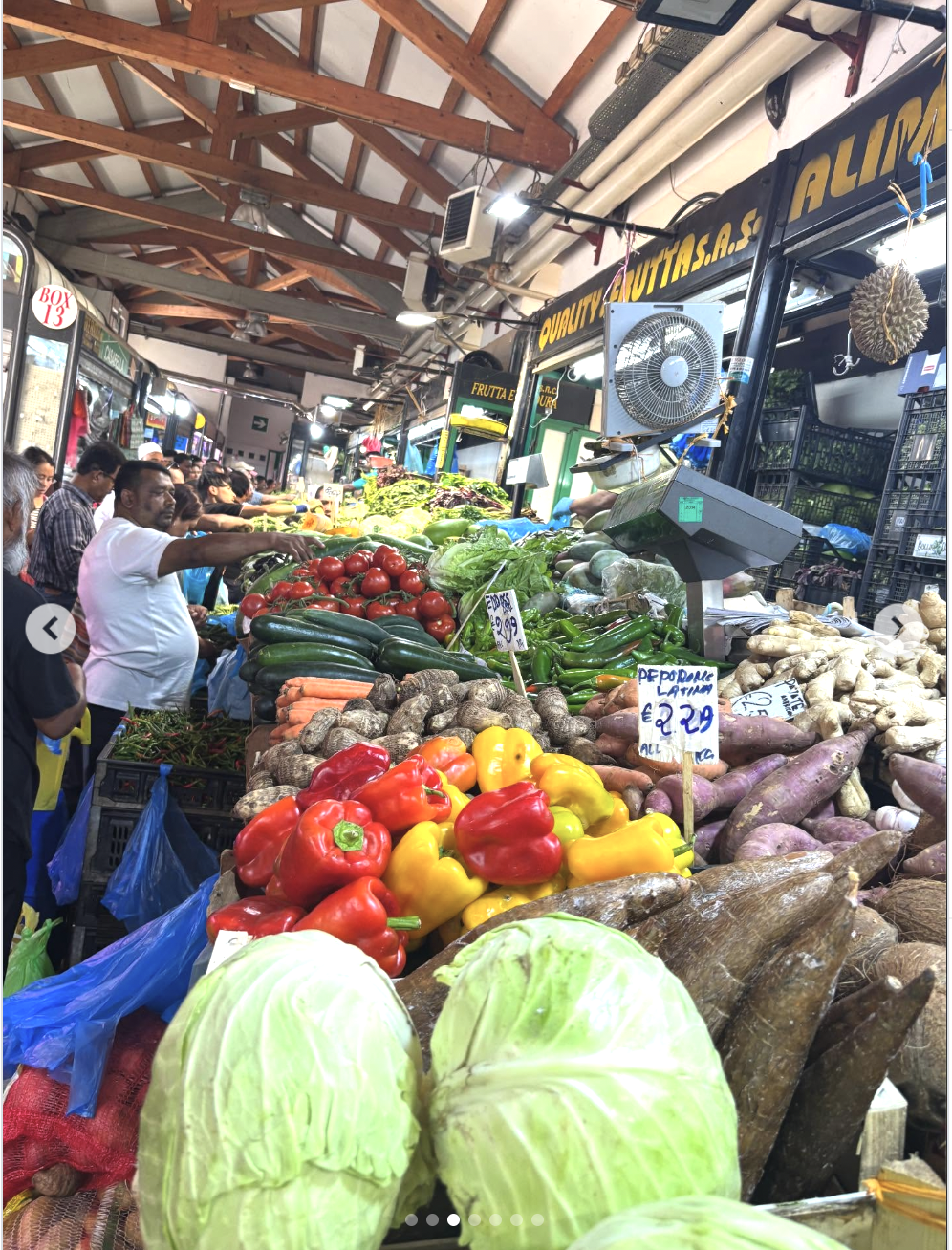
Located just beyond Termini Station, Rome’s main transport hub, Mercato Esquilino felt like a different city altogether. The polished familiarity of Testaccio gave way to something more chaotic, more multilingual, and more global. Here I could find daikon (my favourite vegetable) – alongside Asian greens, chilies from across continents, spices I recognized from years of travel, and ingredients that reminded me of homes both real and temporary.
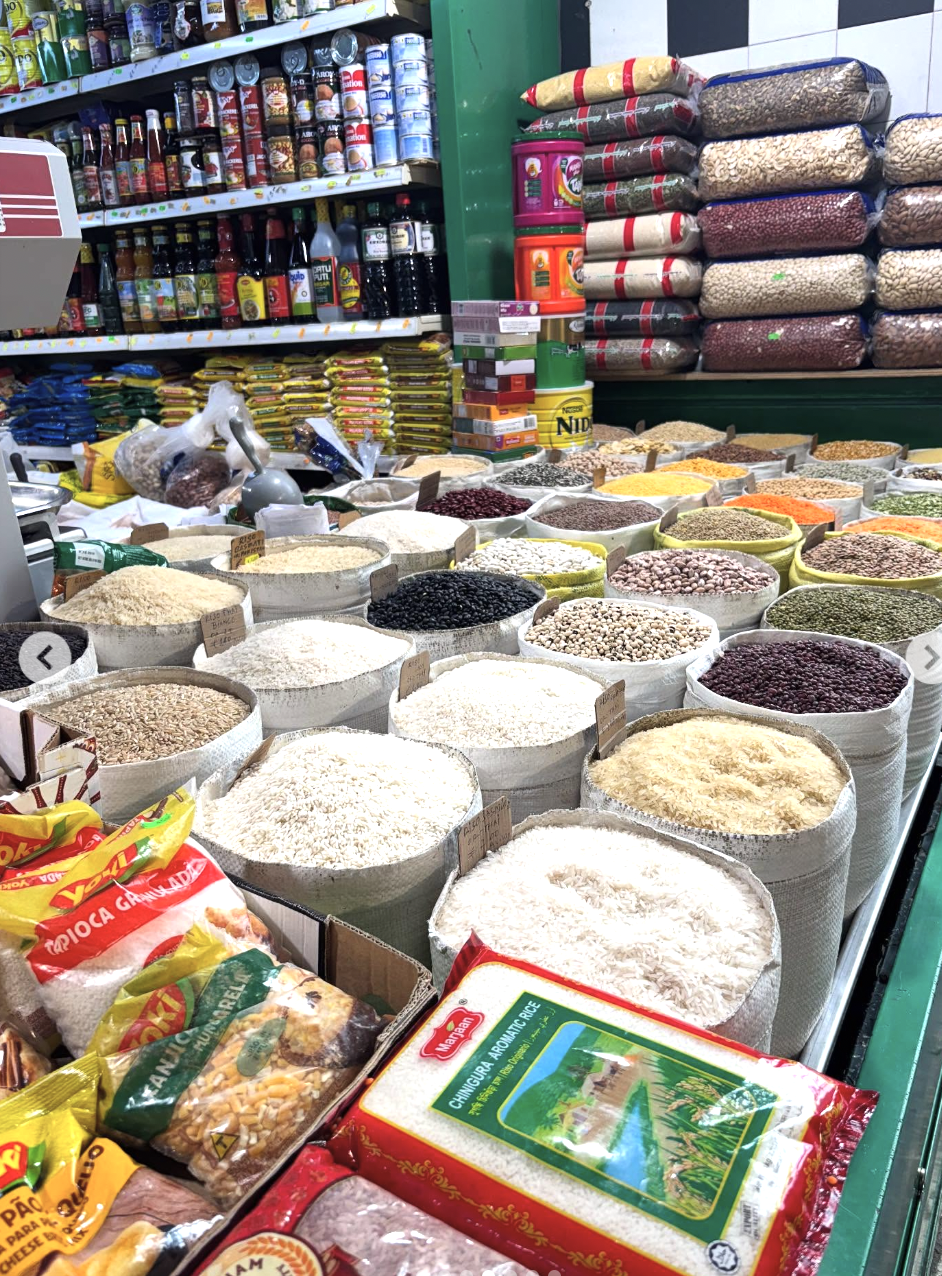
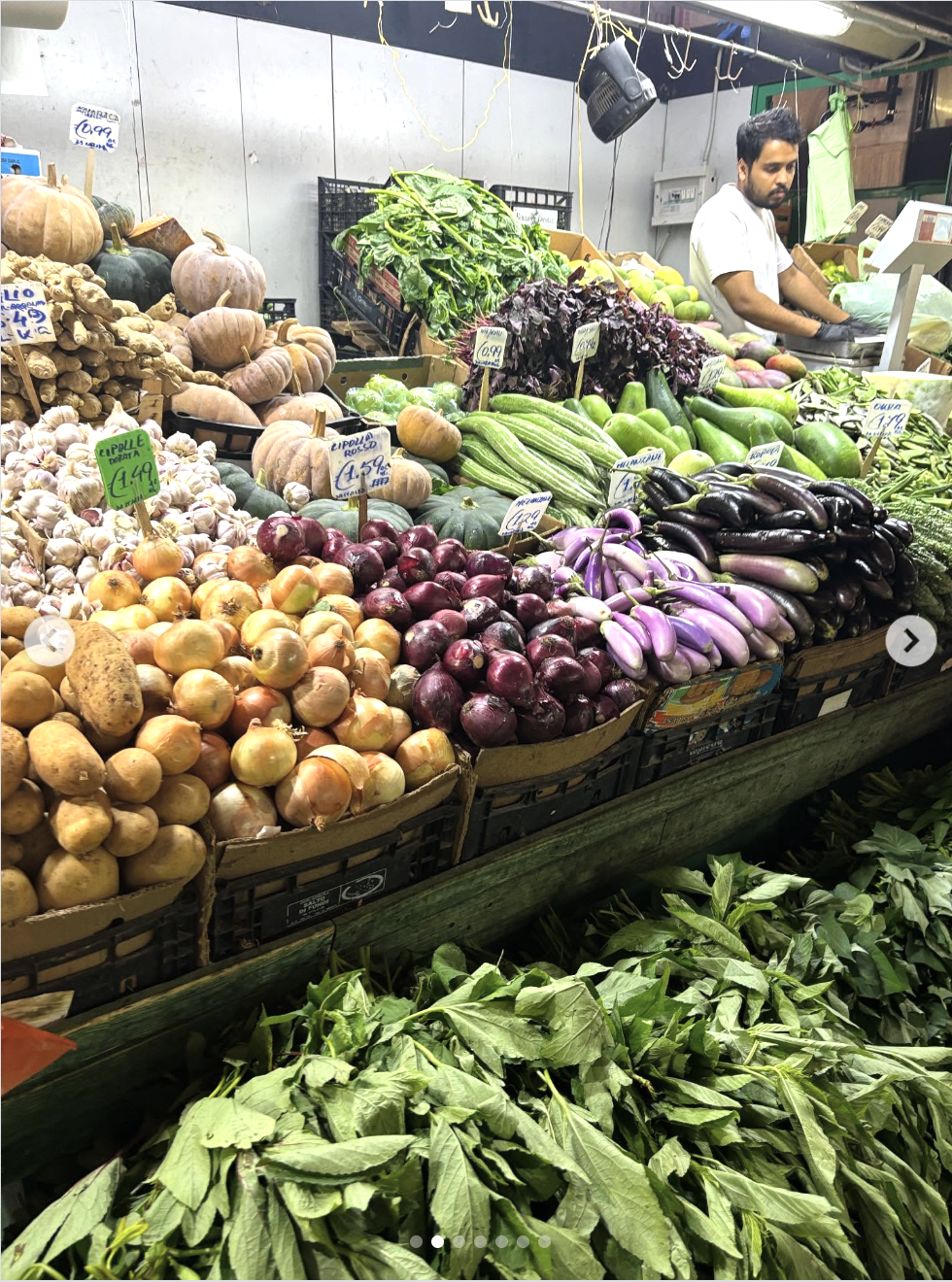
Mercato Esquilino is not the Rome that appears on postcards. It was something altogether different: a reminder that modern Rome, like so many great cities, has been shaped by people, ingredients, and influences arriving from elsewhere.

The first thing you noticed was the noise. Vendors called out to customers. Conversations unfolded in dozens of languages.
One afternoon, my family called from Australia while I was shopping.

“Where are you?” they asked.

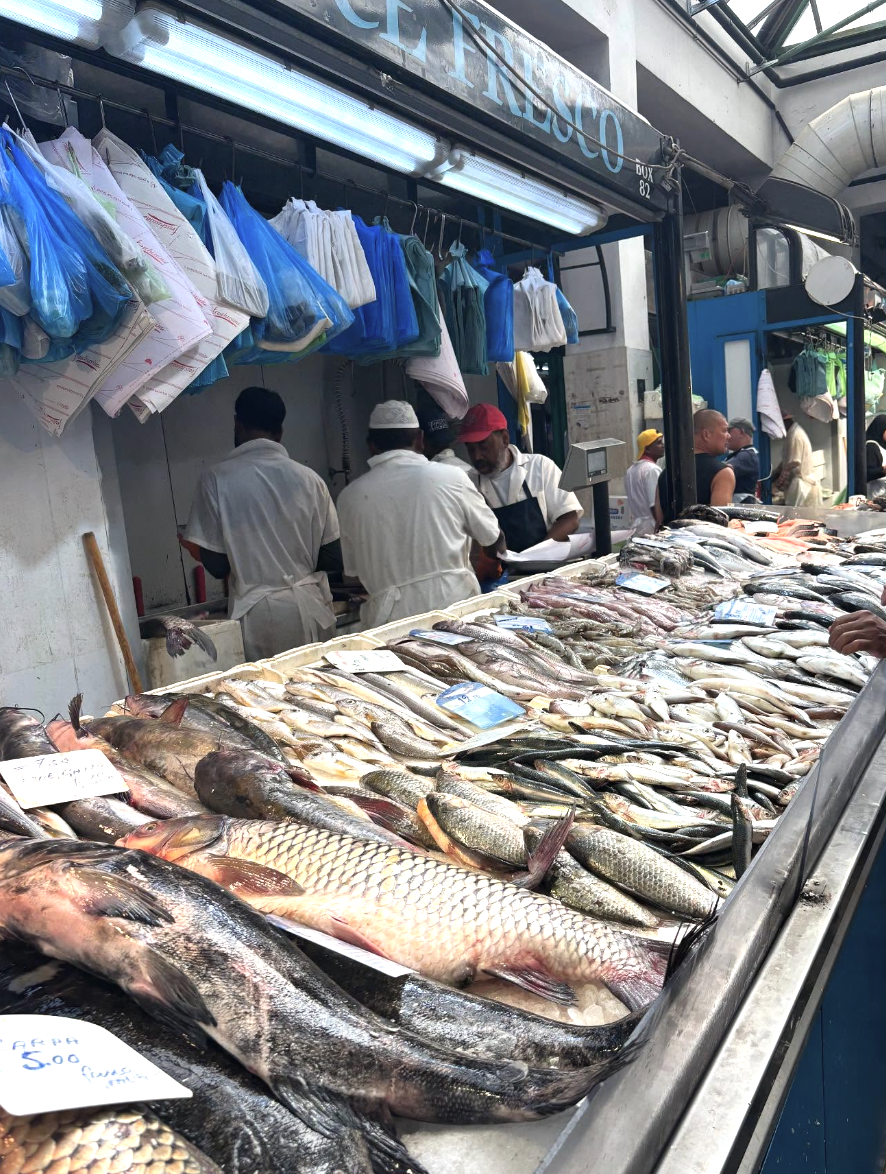
I turned the phone camera on so they could see: the shouting vendors, the bustle, the rows and rows of whole fish on ice. It was the sound of a market that felt almost unchanged from another era. For a moment, they were transported there with me.

I rarely arrived with a strict shopping list. More often, I came searching for ingredients that I was missing, craving. The Bangladeshi shopkeepers soon began to recognize me.

“How do you know this stuff?” one asked, laughing as I filled a basket with ingredients that most of their Italian customers ignored.

Today, as summer begins to arrive in Canada, I find myself thinking about those Friday afternoons in Rome. About Testaccio and Esquilino. About old friends who somehow find each other again in distant cities. About market vendors who knew exactly what I was looking for before I asked, and the simple pleasure of wandering home with a bag full of ingredients and no particular plan.

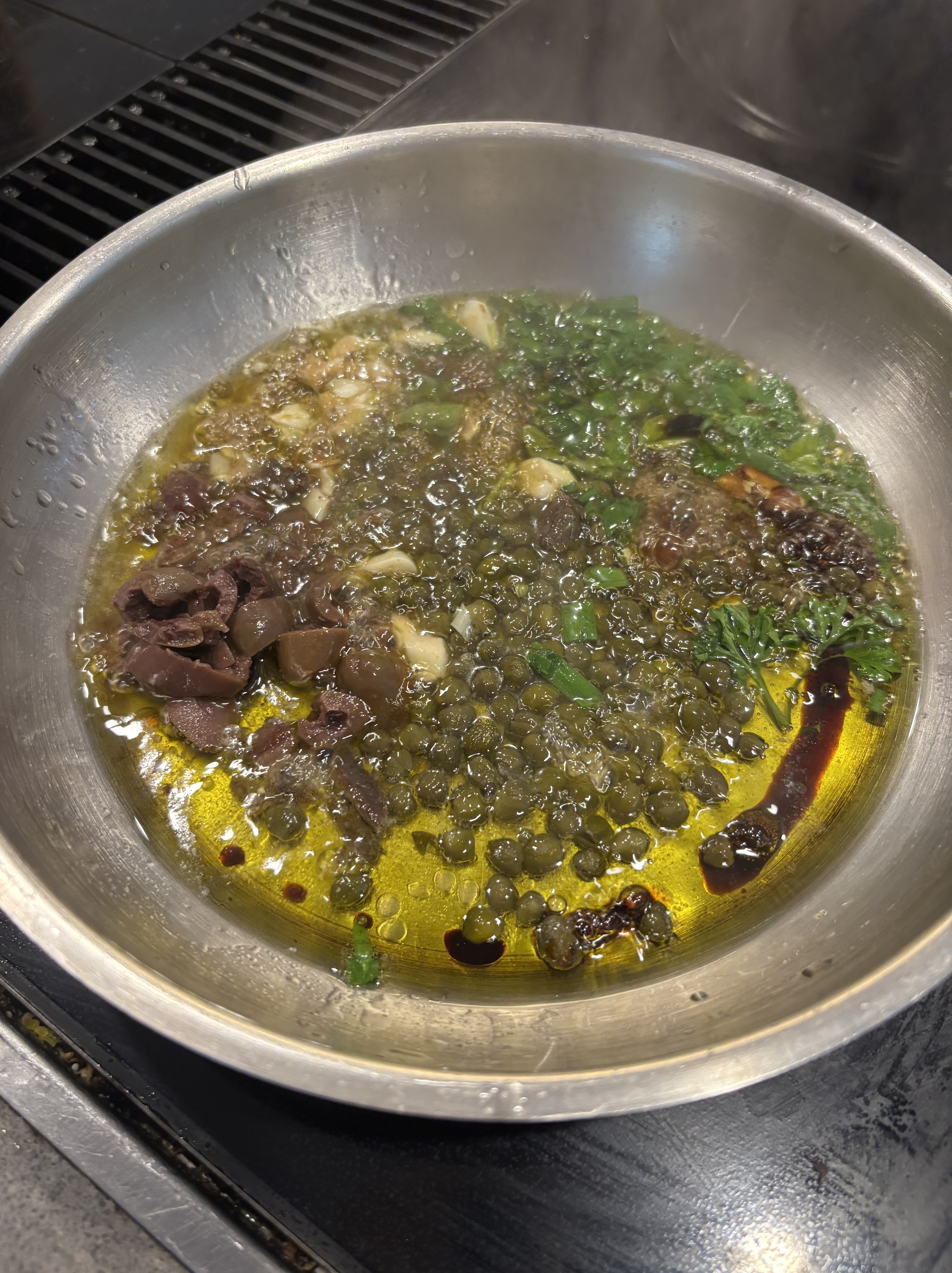
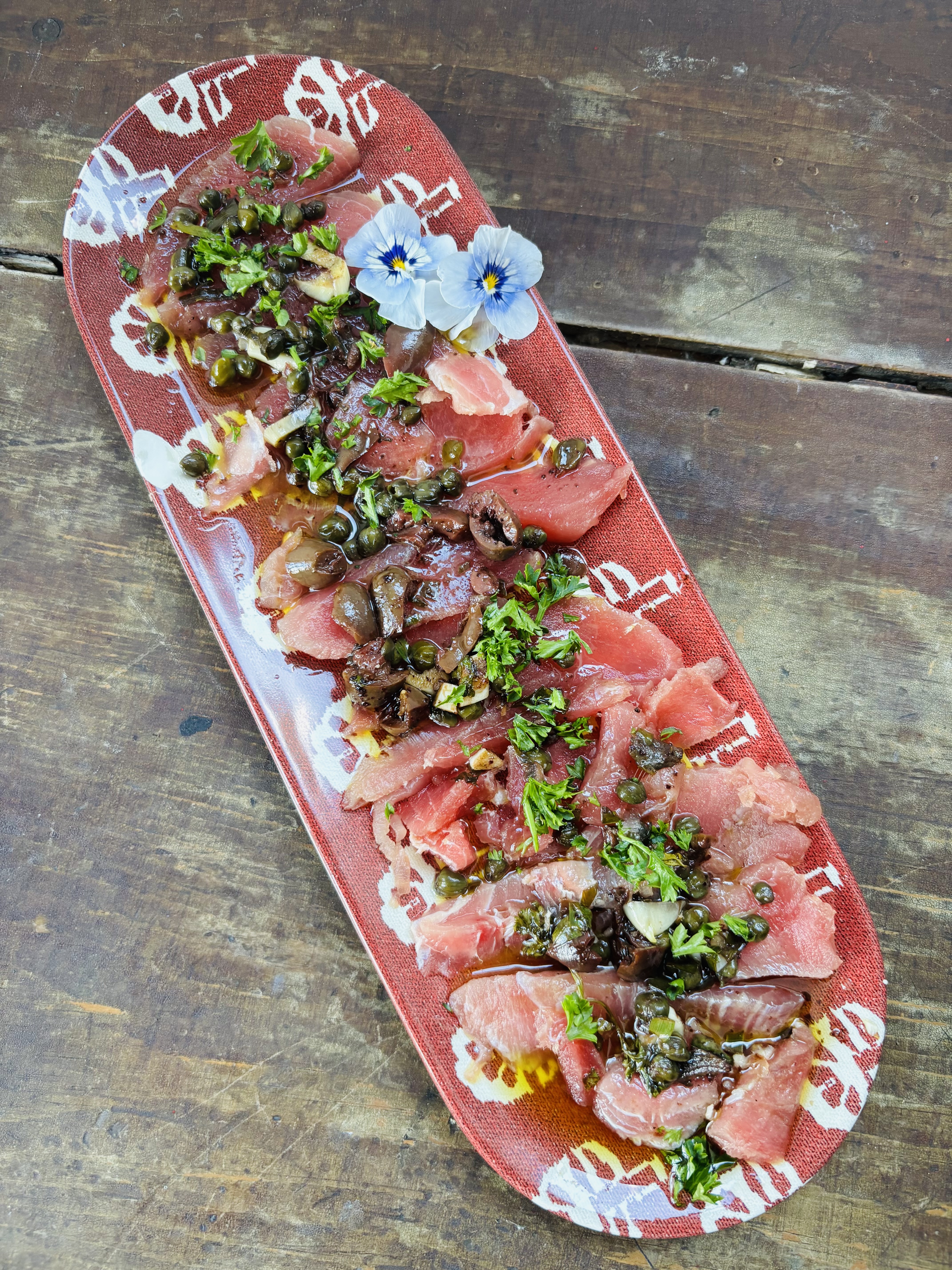
I’ve been back in Canada for a while, but some tastes just follow you home. Case in point: tuna carpaccio. I originally stole this recipe from Gennaro Contaldo, who famously mentored a young Jamie Oliver years ago – and it became a staple of my time in Rome. Although I’ve made it for years, it has a renewed focus for me lately thanks to two game-changers: amazing fresh, salt-brined capers from the market, and the addition of sumac. Fresh tuna, good olive oil, balsamic, sautéed garlic, and fresh herbs are your must haves.

So as I sign off today, and hopefully not for as long as last time – I’ll leave you with this small reminder that sometimes the best souvenirs aren’t things at all, but flavours, friendships, and the places that brought them together.

Tuna Carpaccio

Ingredients: A steak of sushi-grade tuna, handful of olives and another of capers, or either-or. About half a cup of olive oil, some splashes of balsamic, a few cloves of garlic smashed (do not finely chop) and some herbs of your fancy, some sumac.

How to: In a small pan, gently heat up some garlic, capers, olives and half of your herbs. Add a few splashes of balsamic vinegar. Heat on low for about five minutes, stirring. You do not want your garlic crispy.

To slice tuna for carpaccio, freeze the fish for about 15 minutes so it is firm and easy to handle. Do not keep the fish in the fridge if you are not using immediately, it must be kept frozen. Use a razor-sharp knife to cut paper-thin, translucent slices across the grain using one smooth pulling motion. If you want the pieces even thinner, place plastic wrap over the slices and gently flatten them with the back of a spoon. Arrange the tuna on a plate (chilled preferable), and then spoon your mixture over it, garnish and sprinkle with more sumac or a few chilli flakes.
Bon Appetito.
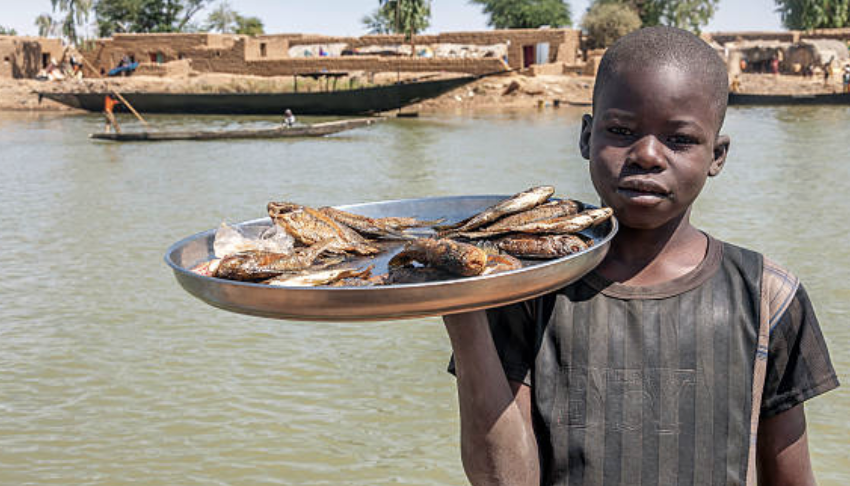
The boy who lived in the market, Chad, Africa

The boy who lived in the market, Chad, Africa

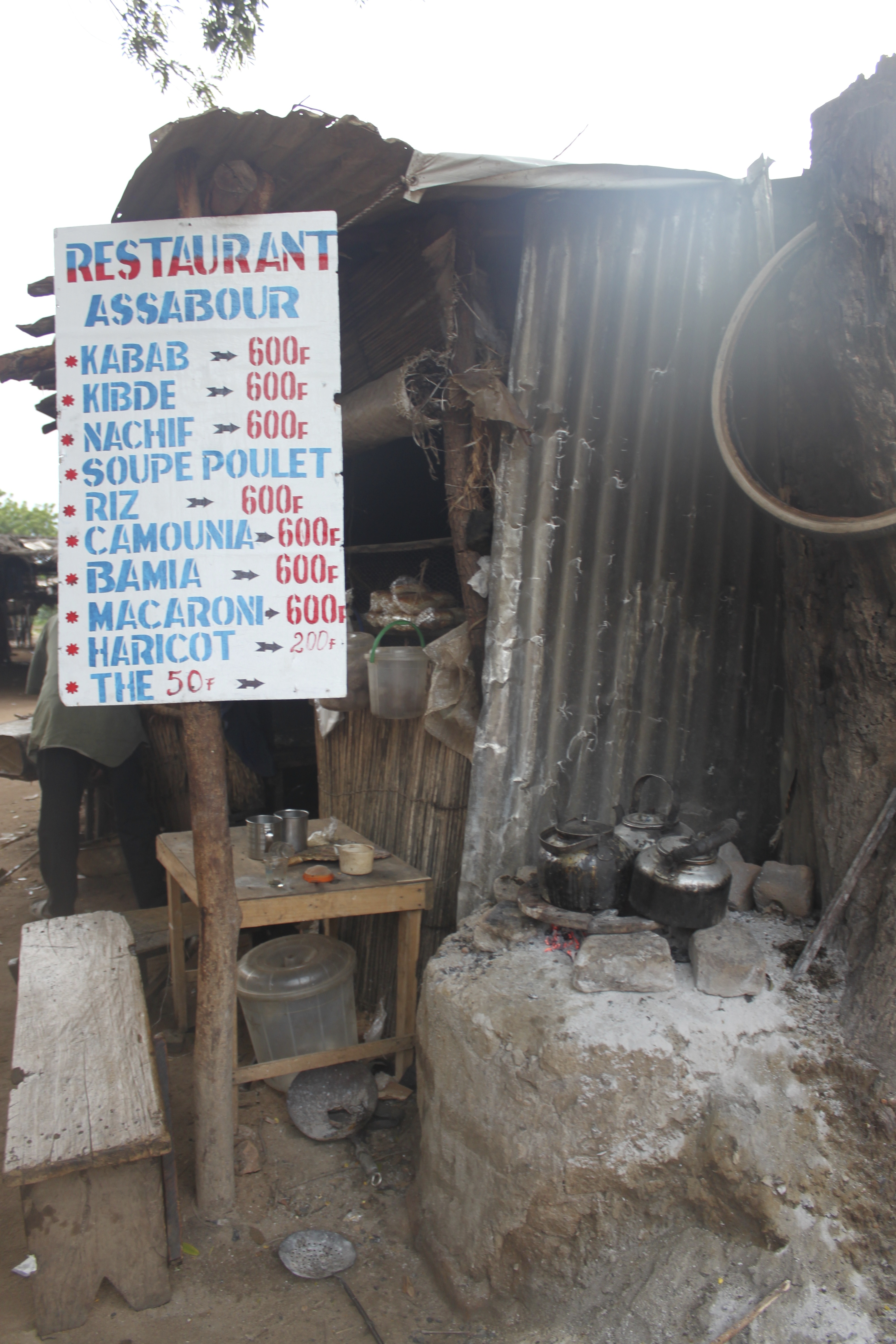
Recently, I had the opportunity to work in Chad for a humanitarian assignment. Chad is a landlocked country situated in the Sahelian region of Africa, to which the average traveller probably wouldn’t deign visiting.

Burdened down by years of conflict, the last few years have been easier to Chad, with it now being one of the most peaceful countries in the region.

From the capital of N’djamena I flew to the far south-east of the country, which is greener, lusher than the dry north.  It was also here that several humanitarian agencies have set themselves up and are working mostly in the camps where they receive the influx of refugees arriving from neighboring Central Africa Republic (CAR). The majority of them providing life-saving food security, nutrition or water interventions, as well some providing health and education services.

IMG_3917

I visited one of these camps in the district of Maro, where the immediate future of these people remains as unsure as the 10.4 million other refugees around the world (UNHCR, 2012) with some 28% presently living in Africa.

After the camp, a colleague and I ventured into Maro’s small town. It was the late afternoon, so we had missed the market.  Along the way, we bumped into some Chadian colleagues who were visiting friends that owned a small store along the main road.

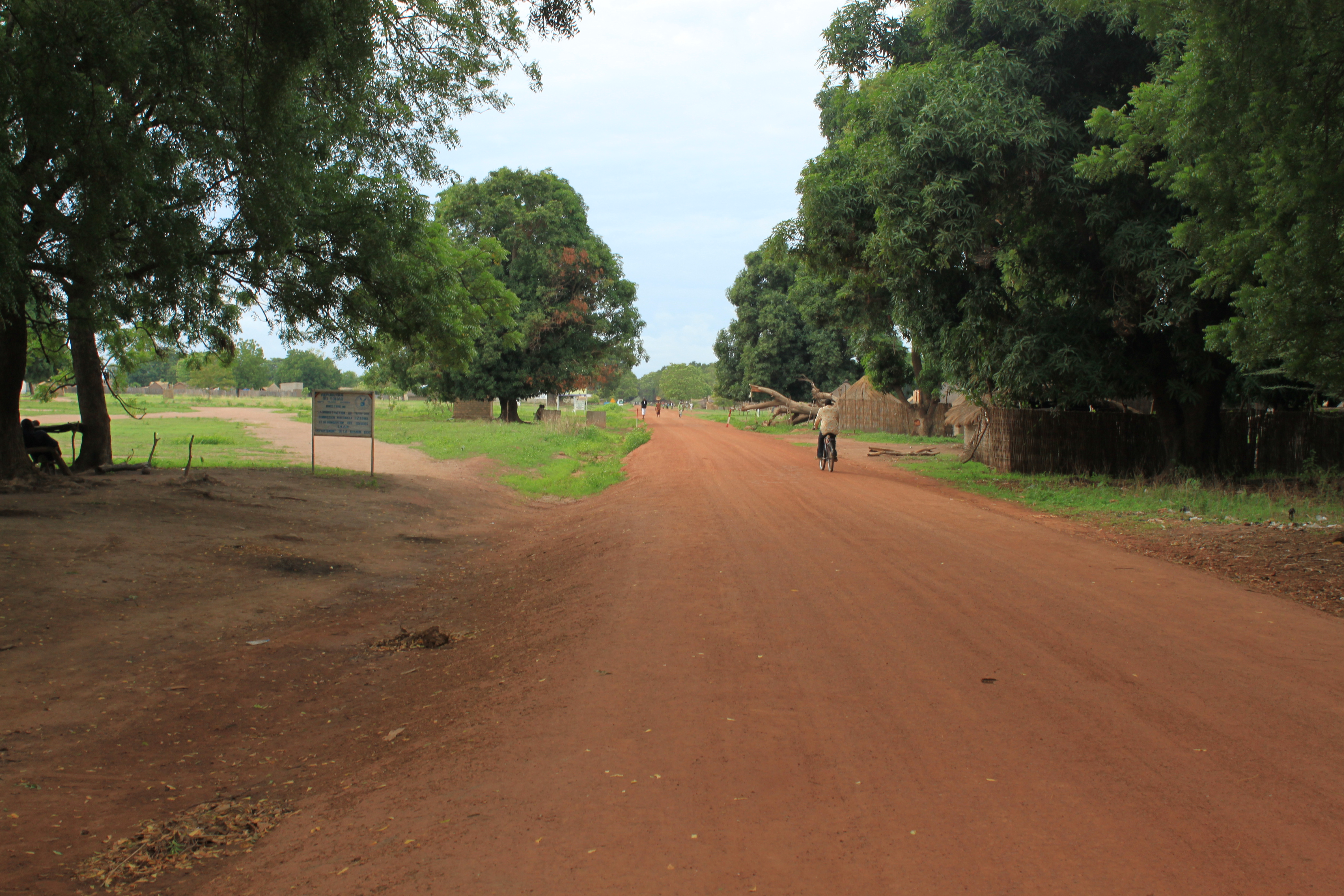
The long road reached its red-dirt arms as far as the eye could see.

“Where does this road lead to?” asked my Canadian colleague.

road

“The Central African Border is an hour away.”

“This is the road that the refugees take to reach this part of Chad,” they explained.

We spoke for a moment how we could well imagine them arriving by foot, tired, hungry, hoping to find safety, a small place which they could somehow call “home”.

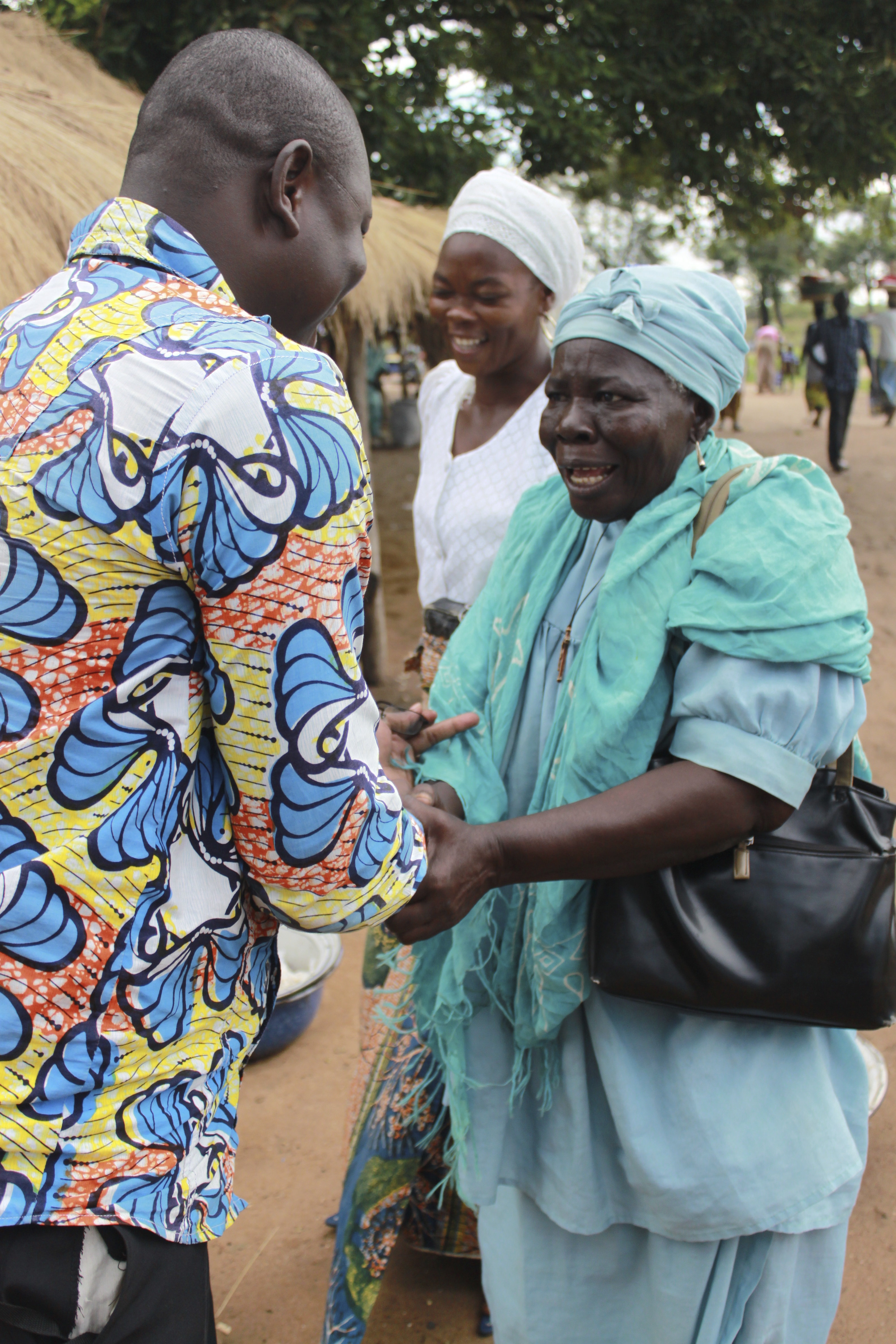
I visited three markets in Chad. One was a few hours drive away from Maro in a town called Sahr. It was Sunday, and the Christians had just returned from church, and were stopping to get lunch staples. We stayed only a little while as a convoy was to expected to escort us to the next town, yet it was a joyful moment when one of the team travelling with us ended up bumping into an Aunt who he hadn’t seen in years.

aunt

From there, we drove some 7 hours west to Gore. My days were packed and intense, yet I had an hour to spare after my last day to take a little walk to the Town Square and market with two colleagues.

Unfortunately, the vendors were packing up for the day, and the market was bereft of both content and customers. While I find markets the most vibrant of places, this one was dark and ominous – a gang of street kids ran past and began taunting us. Not getting what they wanted, they took off again. Turning to leave, I noticed a crumpled heap on the market floor, which I first thought was a bundle of old blankets.  I looked closer, and two eyes flashed up at me. It was a child, a boy of around 8 or 9, his face had the glazed look of those who have been so beaten down and harassed by life, that they acquire a strange sort of stillness, a type of inner equanimity that protects them no matter what happens next.

As my colleagues turned to leave, I couldn’t. What could I do? Offer him a home? A bed for the night? I had neither of those at my disposal.  Should have I given him some money. Probably, yet as aid workers, we are dissuaded from this.

The image haunted me on the way back to base, and the next day I asked a colleague about the plight of orphans in the area.  There was a group of Nuns who helped out street children, but there is little being done with the kids like the one I saw at the market.

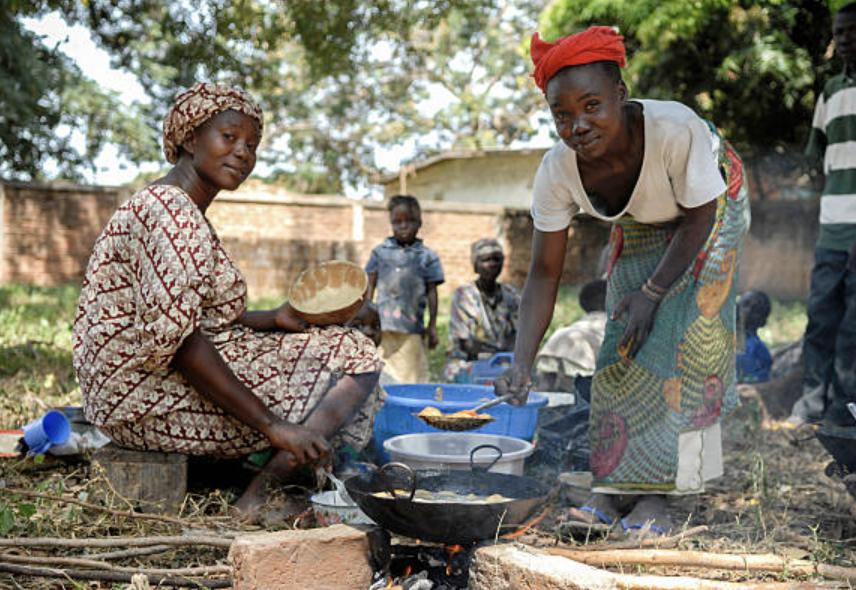
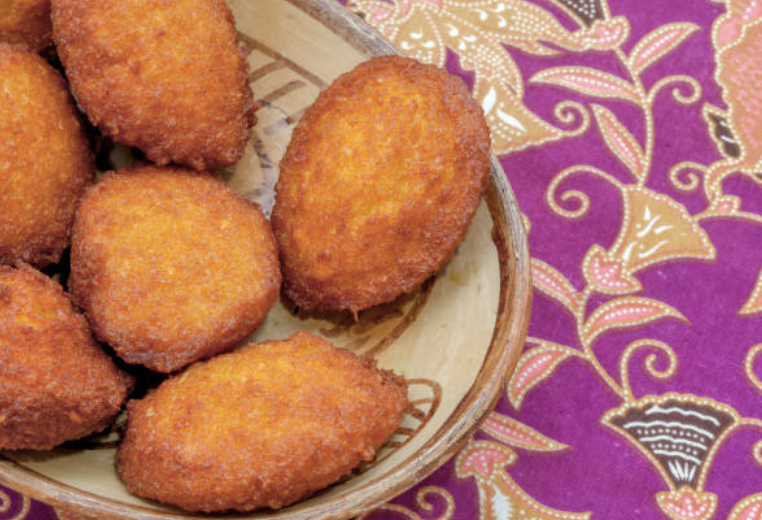
I have often thought of the boy since coming home, and am guessing that he probably worked at the market, as the vendor nearest to which he had set up bed for the night seemed to know him. Perhaps he ran errands for him? Perhaps he sold the fried millet balls that there were ubiquitous along Chad’s streets and markets.

IMG_4030 (1)

I thought back to the street kids and other orphans I had met along my travels – including Sarat who delivered me my newspaper each morning in Phnom Penh, and Hoa, the jasmine seller whose shared dwelling had been burned down and had come up to my restaurant dinner table and showed me the images on the front page of the same paper.

UNICEF estimates that the number of orphaned children has risen by more than 50 per cent in sub-Saharan Africa over recent years, where an estimated 12 million children ages 0–17 have also lost one or both parents to AIDS.

Orphans and other vulnerable children are at higher risk of missing out on schooling, or living in households that can’t ensure food security. They are also prone to suffer from anxiety, depression and are at a higher risk of several diseases. Whilst other family members, or even the community takes in many orphans, there are others, probably like the boy I saw who has nobody to go.

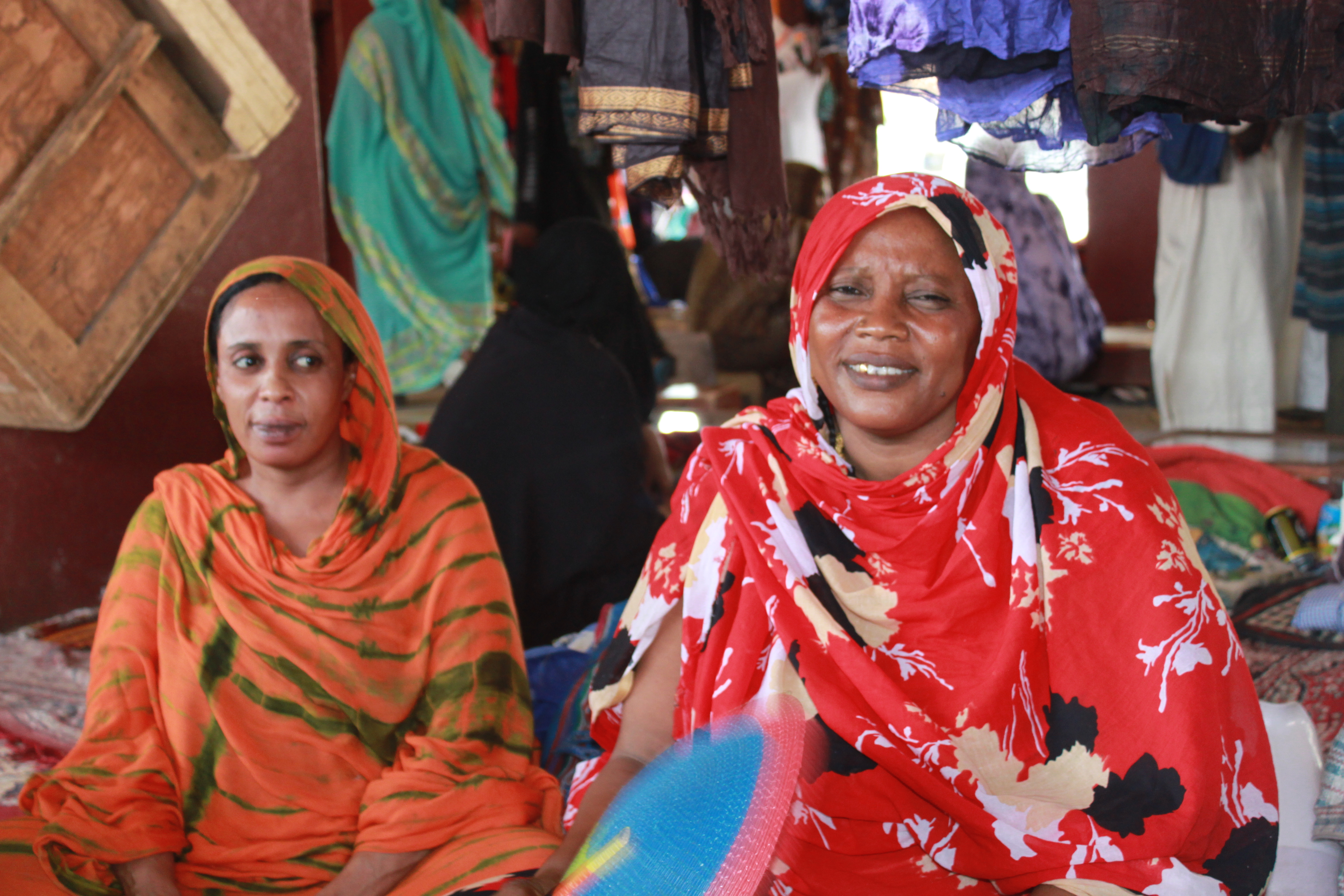
The day before leaving, I visited the Marché Central in N’djamena. It was a giant, colorful and claustrophobic place. Bedouins had brought in giant baskets of tempting dates, all sorts of meat was being sold in the stifling Chadian heat, and a continual broadcast of hundreds of car engines that were left running in the middle of the market deafened out any other noise.  Taking photographs is dissuaded in N’djamena, yet a group of Muslin women selling saffron, other spices and perfumed oils invited me to sit with them before allowing me to take their photo.  Speaking to them, I discovered that many of the market vendors were not Chadian at all, but from Congo, CAR, Guinea, even Darfur.  I wondered whether their own parents had made the long journey over from their homelands with them, or how many had started off their young lives like the little boy I had seen.

IMG_4043

As Summer ends in Canada, and my own eight year old boy goes back to school this week, I reflect on his life and think how the most stressful thing he has to worry about is who to play with on a day-to-day basis, or how to avoid eating his vegetables.  I find myself increasingly grateful that I am able to provide his little self with everything he needs.  I then send a prayer, a thought of hope all the way to Chad hoping that somehow the boy in the market will receive it.  It’s the least I can do.

Millet croquettes

Millet

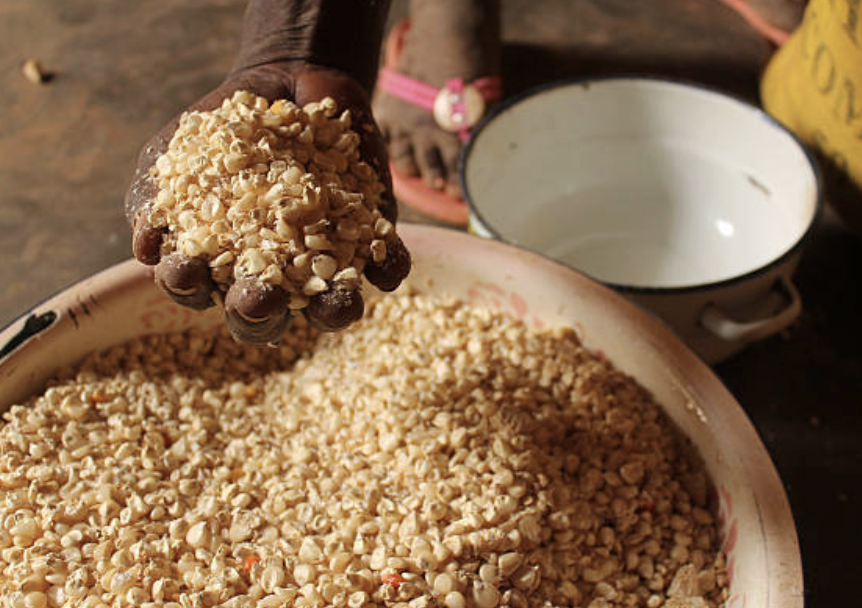
Fried millet balls are a typical Chadian street food, which are served with different dipping sauces. Millet being a staple grain in the Chadian diet, these are my own version with onion and ginger.  You can also add fresh herbs or other spices to the mix.  I served mine with a little peanut sauce, but they are just as good eaten alone.

Ingredients:

A cup of cooked millet

One onion

A knob of ginger

½ cup of flour (any type of flour works well here, I used chickpea flour as it fries nicely)

An egg

½ cup water

½ teaspoon paprika

Salt, pepper for taste

Oil or ghee for frying

Method:

Cook up the millet as per pack instructions. In a large bowl mix all the ingredients into a thick paste. Adjust the mixture with more or less flour until you get the right consistency. Form into bite-sized balls and then fry until golden brown on each side. Serve immediately.

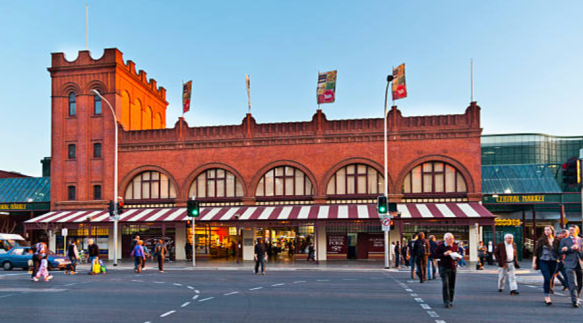
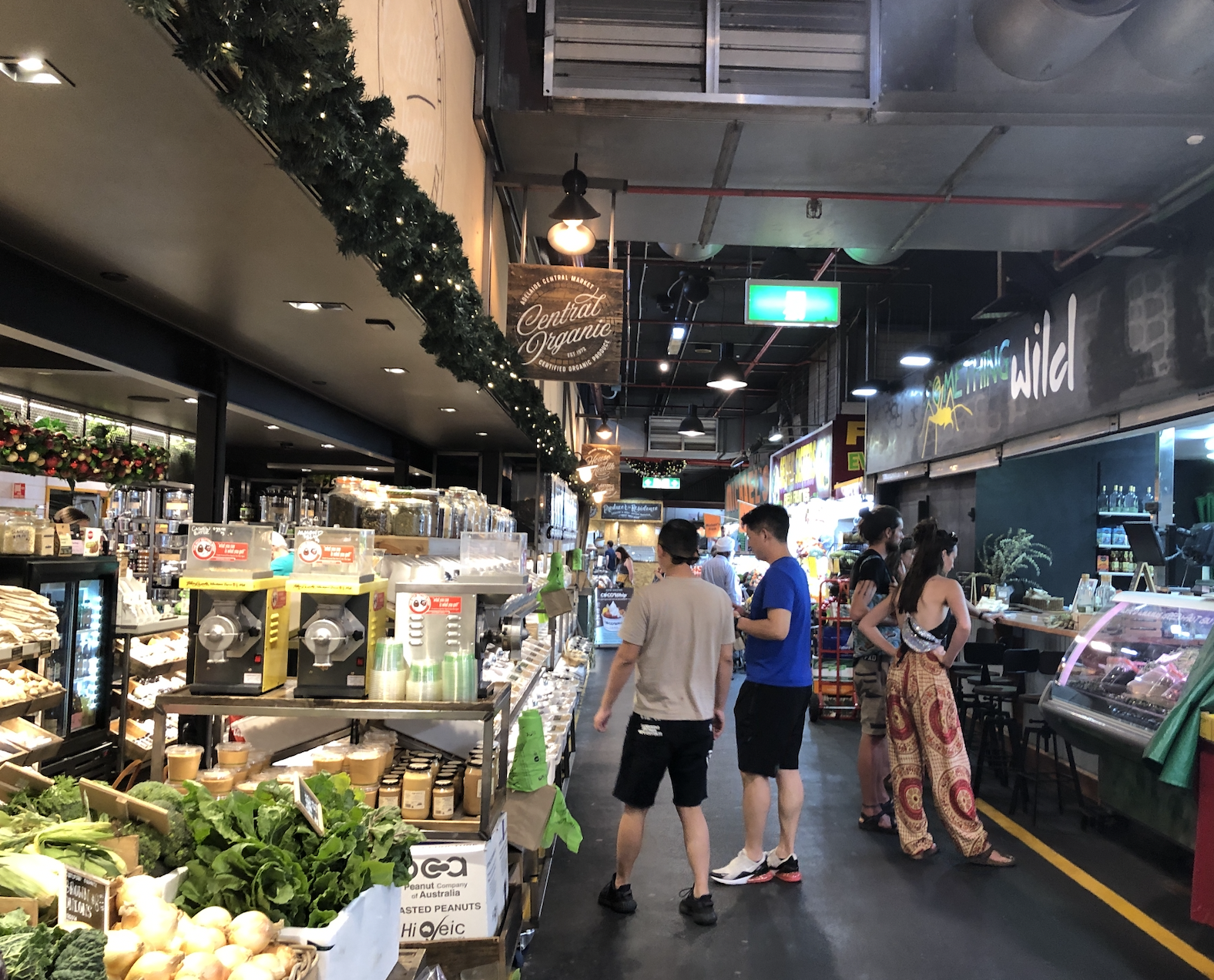
A wink to the bazaars of yesteryear, the Adelaide Central Market, Adelaide, South Australia.

A wink to the bazaars of yesteryear, the Adelaide Central Market, Adelaide, South Australia.179

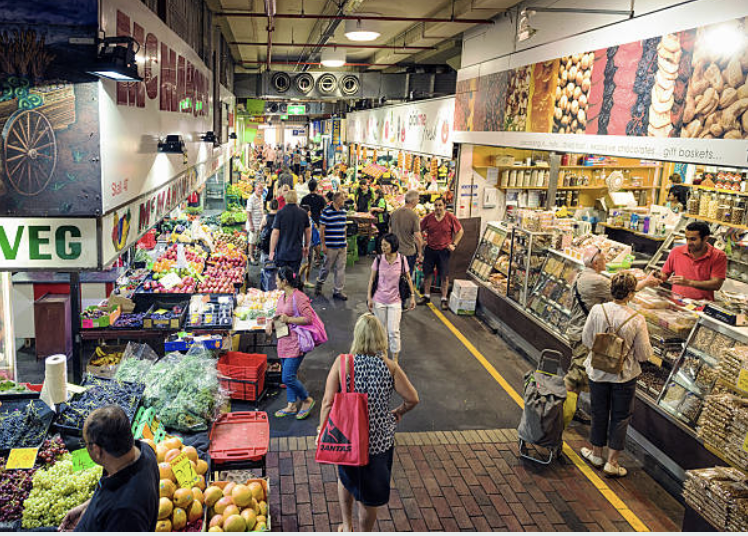
“Cukes for a dollar, five bags left.” “Lamb chops, perfect for the barbie tonight, 10 for $10 bucks, get ‘em while you can!”

It’s ten to three on a Saturday afternoon and the market vendors are auctioning off their food, bellowing out prices at the tops of their lungs. The market won’t be open again until Tuesday, and they need to sell off what won’t last until then. Some of them get poetic, most joke around, but they’re always charming.

174

Growing up in Adelaide, I had never thought that this didn’t happen at other markets, yet every time I go back to the Adelaide Central Market, I realize that I haven’t seen this done much outside of Australia, and I miss it.  This auctioning off of food isn’t actually an Australian tradition. Back in the Mediterranean Middle Ages, subsistence farmers and fishermen would bring their surplus produce to the town to be able to pay their taxes, buy productive assets, send kids to school.  They would then stay just long enough to be able to sell what they had on hand, and back home they’d then go.   If something didn’t sell, they’d then reduce their prices at the end of the market day.  It’s no wonder then that the Greeks at Samtass Seafoods are selling off their barramundi, the Italians their juicy-red tomatoes; it’s as if their ancestral ghosts are here with them today, whispering the best prices in their eager ears.   157

Just like in days gone by, when bazaars were established along trade routes, the Adelaide Central Market, known as “the heart of Adelaide”, is located in the middle of the city, attracting vendors from all over South Australia. Adelaide is also known for being one of the world’s best laid out cities, which makes the market easily accessible to its inhabitants whether they’re from the North, South, East or West of town.

160178I first visited the market as a little girl growing up in suburban Adelaide. Back then in the seventies, if you were an ethnic European immigrant, you had to make a small effort to get your goat cheese, prosciutto, and olives; so families like us, would seek out treasure troves like the Adelaide Central Market, as well as small specialty stores they then called, ‘Continental’ stores.

151

Back in those days, I was teased for my strange smelling lunch box, yet today, Australian cuisine, is in my own humble opinion, some of the world’s best, merging Asian, European and Middle Eastern flavors and fashions and of course taking advantage of the weather and therefore, long growing season.

177

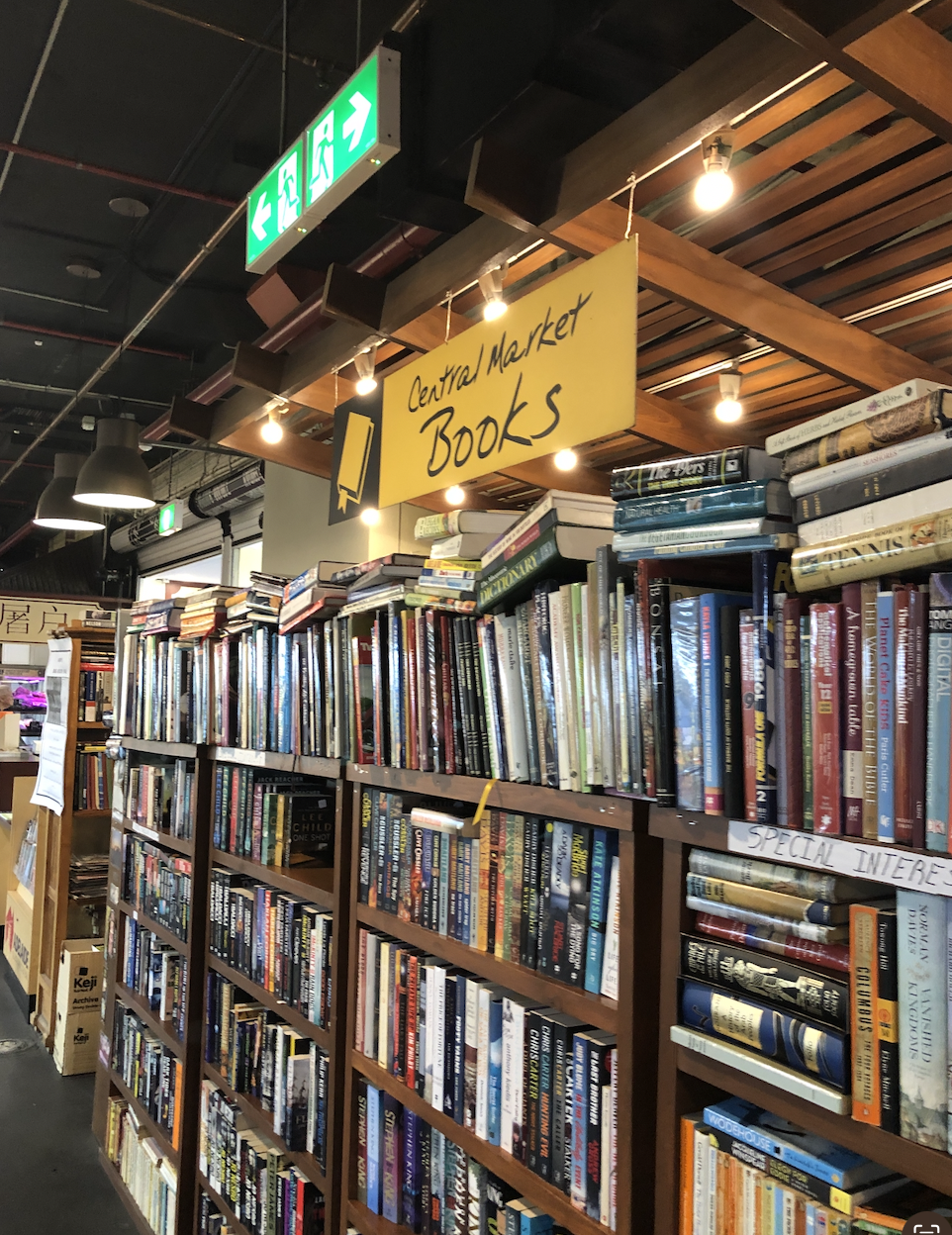
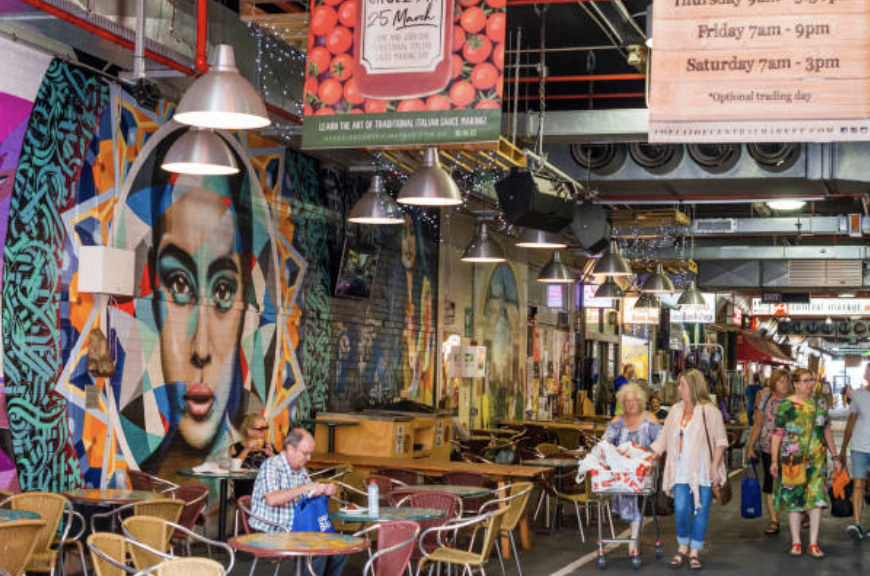
So it’s no surprise that I have always felt at home in this place; at home with the late afternoon food auctioneers, more comfortable sitting on a chair in the middle of the market than in some swank, inner-city café.  That’s the other thing about the market, much like the bazaars of the past, the market is chock full of rustic little cafes and restaurants.  Old timers who have been coming to this market for decades meet up with friends for a cappuccino, a glass of vino. During my last visit, I met friends for lunch, as well as organized a family dinner, in the bordering Chinatown.

158

The market also remains affordable, when I first moved out of home, and having to live on an entry-level public servants income, I would walk over from the government office I was working at, and walk back with bags laden with Turkish pide, dips, cheeses, sour dough bread, that season’s honey from the Honey and Soap shoppe, fresh squid, octopus. I still remember the little yellow buckets of Kalamata olives from the Olive Tree, that I paid a friendly five dollars.

161Probably instinctively knowing then that I would not stay in Adelaide forever, I would gravitate towards the Adelaide Central as if it was some type of home away from home, and now, whenever I go back, it still feels like a visiting a favorite old friend.

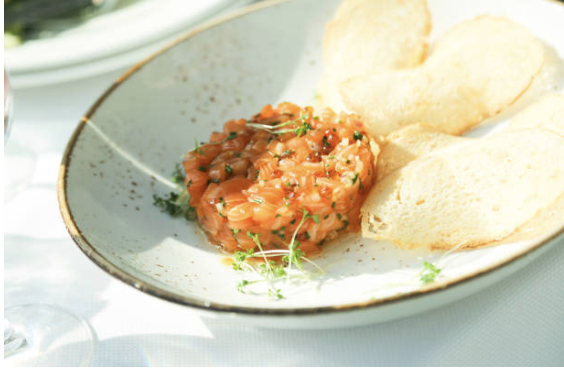
Salmon or Tuna tartare          

IMG_3720

For this blog, I have chosen a recipe, which I hope merges the recent trends of eating raw fish, plays homage to the habits of market vendors of yesteryear, as well making use of the fabulous fish available in South Australia.  In the early days of the market or bazaar, not having the comforts of refrigeration, vendors would need to find innovative means in storing and preserving food. By adding spice and lemon juice to fish, it causes the proteins in the seafood to become denatured, as if being cooked. When buying your fish, make sure to let your fishmonger know it’s for tartare, or ask for sushi-grade fish, which is the freshest. (If I have time, I tend to freeze my fish first, which makes it easier to cut).

Ingredients:

  • 1 lb sushi-grade Tuna or Salmon
  • 2 tablespoons extra-Virgin olive oil (or sesame oil)
  • 2 tablespoons of capers finely chopped
  • 1 finely chopped shallot or 2 finely chopped green onions
  • 1/2 tsp red pepper flakes, or 1 small chilli pepper, chopped finely (seeds removed)
  • Juice of 2 lemons or 2 limes
  • Salt and freshly ground black pepper to season, taste
  • A smidgen of wasabi paste or a little horseradish for extra kick

Method :

Chop the fish into very small pieces. Place in a large bowl and mix in the rest of the ingredientss. Add salt and pepper to taste. If you want the mixture to really absorb the ingredients, place in the fridge for an hour.

Garnish with more lemon or lime wedges and some slices of avocado. (If serving for a special ocassion, cut out a square piece of nori roll paper, put a round cookie cutter on the nori, fill the mould with the tartare, lift off mould to leave a perfect size of tartare).  Enjoy et Bon Appétit!

My favourite market, Rusty’s Market, Cairns, Far North Queensland, Australia

Image

Many years ago, my great-uncle who passed away, left me a small amount of money. This uncle early recognized my restless nature, and would warn my family “that I was divlja (wild).” and “had the unruly nature of a Tzigane (gypsy), and that there would be trouble.” Although he said this half jokingly, he still made it a point not to let me inherit the money until I was in my mid twenties.  When it was finally mine, and determined to prove him wrong, I decided to use it for a home deposit. At the same time, the new job that I had been head hunted for had quickly turned out to be a bore, and to top it all off, the dead-beat on and off again boyfriend had brought me back one too many Days of Our Lives scenarios. Following that, and true to my late uncle’s predictions, I ditched the house plans, packed a few suitcases, faxed in my “sorry, but I am just not into you” resignation and booked a one-way ticket from Adelaide to Cairns, Far North Queensland, leaving the dead beat scratching his head when he returned to my empty flat. The only things I knew about Cairns was that a) it was hot and humid and b) my Swedish born cousin called it the “most beautiful place on earth.” After a back packing trip, he had returned home to Sweden, secured a study grant and moved there, with no apparent intention of ever leaving again.

IMGP0015

The first few weeks were a haze, the environment completely different to anything I had seen.  Unbeknown to me it was the monsoon season, so most afternoons I would return from afternoon walks around town completely drenched.  Cairns is a relatively small city, yet the frontier to two of the world’s great heritage sites – the Great Barrier Reef, and then the Daintree Rainforest. Yet I found even the local surrounds a visual masterpiece; ancient trees grew tall as small buildings, rainforest mountains encircled the city, coconut and avocado grew in backyards. Instead of just the beach, there were nearby crystalline waterfalls, serpentine coloured water holes and mountain top lakes to swim in.  Large lizards would stop by whilst I sun-baked. The song of the cicada would sing us to sleep.

 IMGP0017

Asides from my cousin, and a few of his friends, I didn’t know many people at first, so would spend most of my time exploring the city and nearby surrounds. One day, I stumbled across a semi open space, which from the outside appeared to be a large, unused factory.  It was the music that first drew me in – a local Indigenous band was playing some drums and the didgeridoo. Walking in deeper, I discovered the most exquisite looking market space I had ever seen – the produce, much like Cairns itself, was exotic, vivid in color, sumptuous. There were tables and tables of tropical fruit and vegetables: prickly pears, luminous star fruit, pungent durian, and then bunches of aromatics and fresh spice: lemon grass, turmeric, Thai basil, different mints.IMGP0083

IMGP0075

Tropical flowers sold for cheap, and bare-chested hippies sliced open fresh coconuts, others whizzed up cold pineapple crush. A Turkish immigrant set up shop selling labneh, burek, and falafel. Due to the proximity to the Torres Strait, Indonesia, and even South East Asia, meant that people’s from these places had also set up stall – so it was here that I tried my first ever Laotian food, Indonesian randang, and it was also here at Rusty’s Market that I developed my enduring crush for coconut milk.

IMGP0068

Back then, Rusty’s was a simple set up  – the stalls were set up on old tables and benches, in no apparent order, and by the end of the afternoon it could also get quite sticky and hot in there. At the same time, Rusty’s was always environmentally friendly, with plenty of cardboard boxes made available to shoppers to carry their bounty home. Initially opened by local man, Emrys “Rusty” Rees, the place has grown to be an important fixture for both locals and tourists. These days, having been taken over by Gilligan’s, a backpackers resort, Rusty’s has had a make over, which I heard from local’s, makes life a lot easier for the people that work there.  The 180 something stall holders are mostly farmers who grow their produce regionally.  Asides from fruit and vegetables, there are also baked goods, seafood, cheeses, nuts, coffee and locally grown teas and more .

IMGP0073

I ended up living in Cairns for three and a half years, and even returned to get married there. Last week, I went back to visit my cousin, who like me, now has a young family. After a meeting up with a friend for breakfast on Friday, we crossed the road to Rusty’s, where I assembled a picnic lunch including Turkish spinach, pumpkin and feta filled flat breads, rambutan, freshly baked focaccia, dips and even some chacuterie. Asides from feeling like you have walked in to a Gauguin panting, the truly great thing about Rusty’s is it’s accessibility.

IMGP0067IMGP0069

Unlike many farmers markets in the developed world, which are sadly becoming more of a bourgeoisie spectator event, a place to be seen at rather than a central and affordable place for farmers to trade and locals to buy fresh groceries; Rusty’s Market is for everybody. Later that afternoon, I returned with my cousin-in-law to do her weekly grocery shopping.  She stopped by a stall whose owner knew her and my nephew by name.  “That guy,” she said after we walked away, “probably knows more about my life, than many of my friends.” Rusty’s is a true reflection of this vibrant and welcoming place called Cairns, prices remain low, it holds no pretense, and will probably remain my favorite market until next time I visit.  For further information about Rusty’s market, visit the market website here: http://www.rustysmarkets.com.au/

Banana leaf fish with coconut milk    

IMG_3623

Most of us aren’t fortunate enough to live in the tropics, yet banana leaf can be found in the freezer section of most Asian or Latin American grocery stores for cheap.  If you don’t want to use the banana leaf, parchment paper works just as well. This dish, which is baked in an aromatic coconut sauce can use any firm white fish.  The same sauce used for baking the fish, I then used to make coconut rice.  Let me know if you try it out.

Total Prep and Cook Time: 35 minutes

For 3 people.

Ingredients:

2-3 fillets of whiting, cod, or other, harder white fish.
3 banana leaves (thaw if frozen, then wipe down any residue with a paper towel) or, alternatively 3 sheets parchment paper

Coconut sauce:

2 stalks of lemon grass
juice of one lime
1 thumb-size piece galangal (or ginger), sliced
2 tsp. mint
2 Tbsp. fish sauce
1 can coconut milk
2 kaffir lime leaves,
1 small red chilli (optional) salt, pepper to taste

Method:

  • Place sauce ingredients in a small saucepan and gently cook to let the aromatics infuse the coconut milk (about 15 minutes). Remove from heat and then blend in a food processor (or blender)  (If you don’t have a processor, chop the ingredients up and stir together.)
  • Arrange a large enough size of banana leaf on a flat surface and place the fish on top. (I also added some vegetables to my recipe by slicing up some green beans and capsicum and placing these on the banana leaf under the fish). Cover both sides of the leaf over the fish.
  •  Fold both the ends in to make a packet. Turn the folded side down to ensure the sauce does not seep out.
  • Place in a baking tray and bake for 15-20 minutes. at 350 degrees, or until the fish is done.
  • Serve with coconut rice and an avocado and mango salsa.

Coconut Rice. Taking one cup of the coconut sauce (which has yet to be blended) and half a cup of pineapple juice (or water if you prefer).  Bring rice to rapid boil, stirring continuously (otherwise the coconut will stick and become gooey).  Turn down the heat and cook for another 15 minutes until rice is done. Do not open the saucepan whilst cooking.

Nostalgia noodles, the markets of Burma by guest blogger Tihana.

Aside

NOSTALGIA NOODLES by Guest Blogger, Tihana

I met Tihana about seven years ago in a writing class.  She wrote about ghosts from the Orient and characters who practiced Kung Fu and supped on shark soup. When her latest travel adventure took her to Burma, a country at the top of my future travel list, I made her promise to blog for me.  Nostalgia Noodles takes us on a hungry train ride from Mandalay through breathtaking hills and valleys and on to Hsipaw, North East of Mandalay.   The train built by the British was designed to improve trade to this Northern State, once under British rule.  All on board!

I had been on the train since 4 am that day and had only had a boiled egg and a piece of white bread for breakfast.  There hadn’t been very much to buy at the Mandalay train station asides from some packets of wet tissues and water bottles with broken seals.Image

 The train journey to Hsipaw was supposed to take about 11 or 12 hours, more or less, rather more than less, actually, because trains in Burma are notoriously unreliable.

I had bought an Upper Class ticket, thinking that perhaps tea would be served, or some sweets, or even lunch. It wasn’t the case though, and the only notable advantage of paying 8 USD instead of 4 USD for the Ordinary Class was the access to cushioned seats.

The other passengers in the carriage were mostly foreigners. A friendly Australian traveler shared a mandarin orange with me. Her husband was commenting about the terribly sweet instant coffee they serve in Burma, the only type one seems to find there. From the window, I was looking at the hills and fields, chicken running around shacks, children running around cats and dogs, all bathed in the yellow light of the January sun. The scenery was enchanting. However, I was getting hungry and was slowly chewing the acidic little mandarin, hoping for a proper meal soon.

IMG_2407

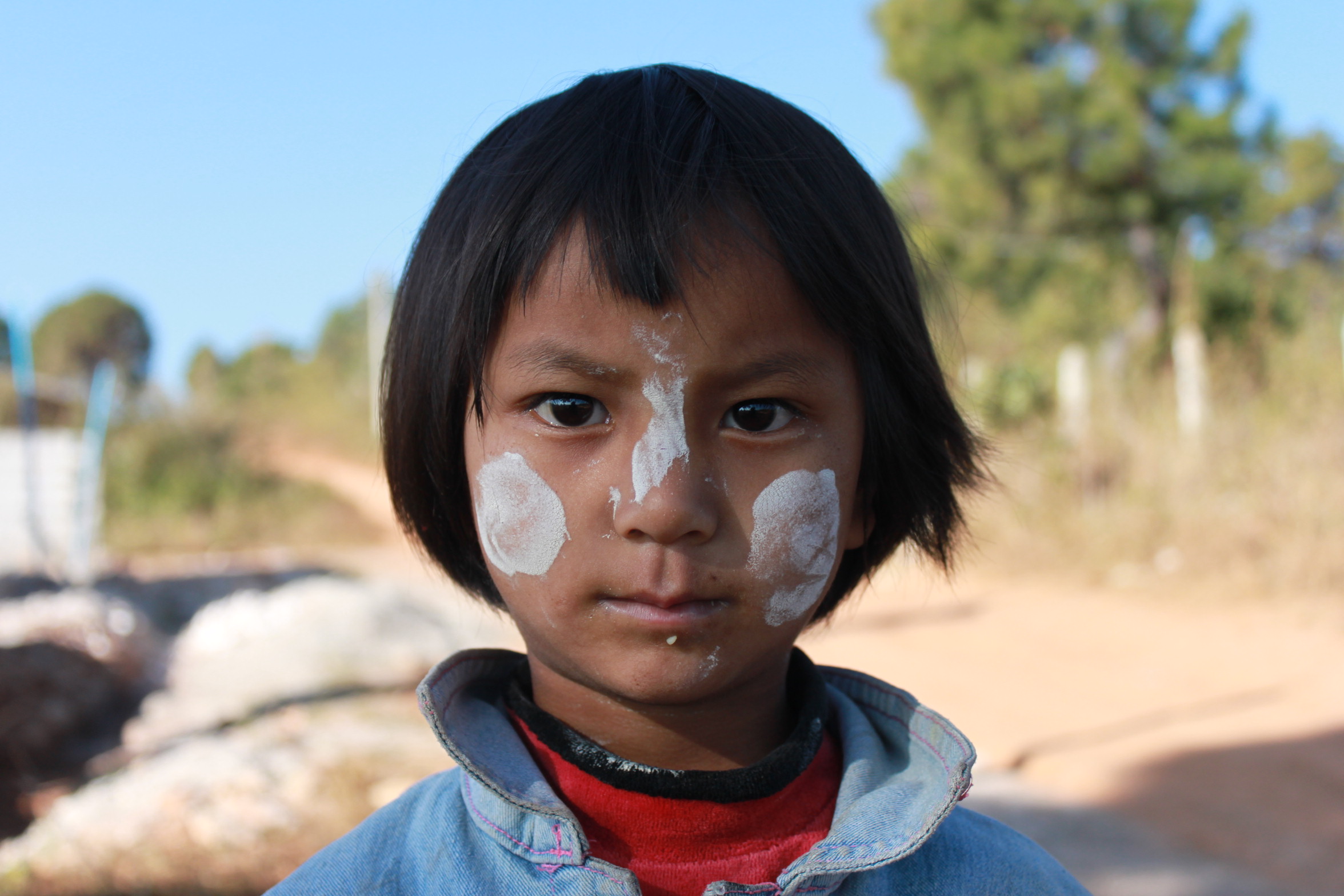
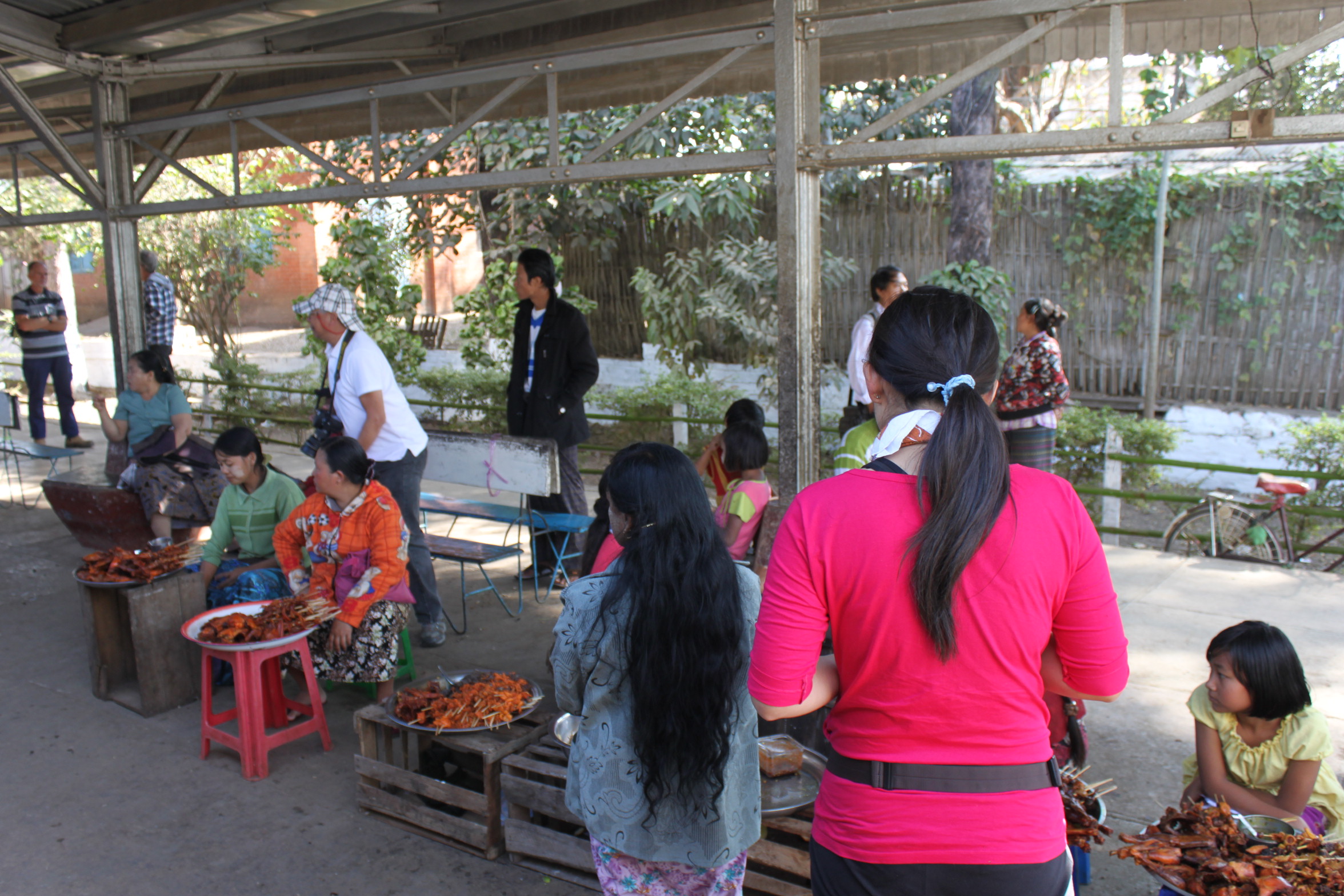
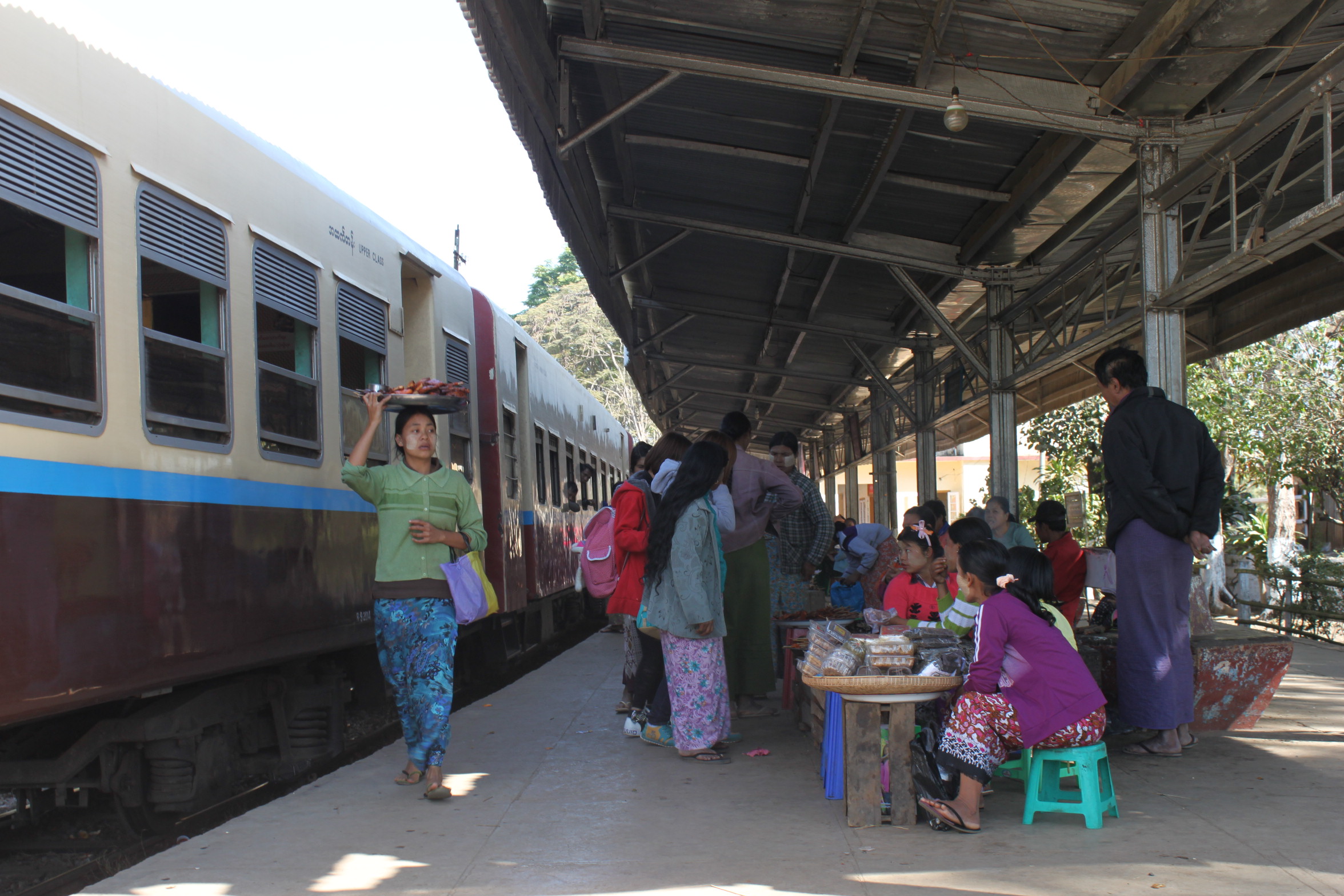
Then, at one station, where we should have stopped only 3 minutes or so, the train came to a complete halt. Many passengers stepped outside. I did as well, my camera ready. On the platform, in the shade, women in colorful skirts, their cheeks painted with the white thanaka paste, were selling their wares: eggs, packages of cookies, grilled chicken, pork and unidentifiable vegetables on skewers. One woman, crouching behind her portable stove, was frying what looked like tiny plump chickpea flour cakes. A half a dozen of those cost 200 kyats, or 25 cents. I ate twelve cakes, savoring each bite, letting it slide down my throat, still hot, very greasy, the most delicious street food, feeling the hunger disappearing.

Everywhere you go in Burma you will find a market, big or small, and see street cooks and street vendors, mostly women, squatting next to their baskets and stoves, sometimes behind stalls and tables. For a few hundred kyats, never more, you can buy grilled corn, grilled animal bits, fish balls, spicy roasted nuts, fruit, sweets, flat soy patties, noodles, and of course, these wonderful chickpea cakes.

3Image

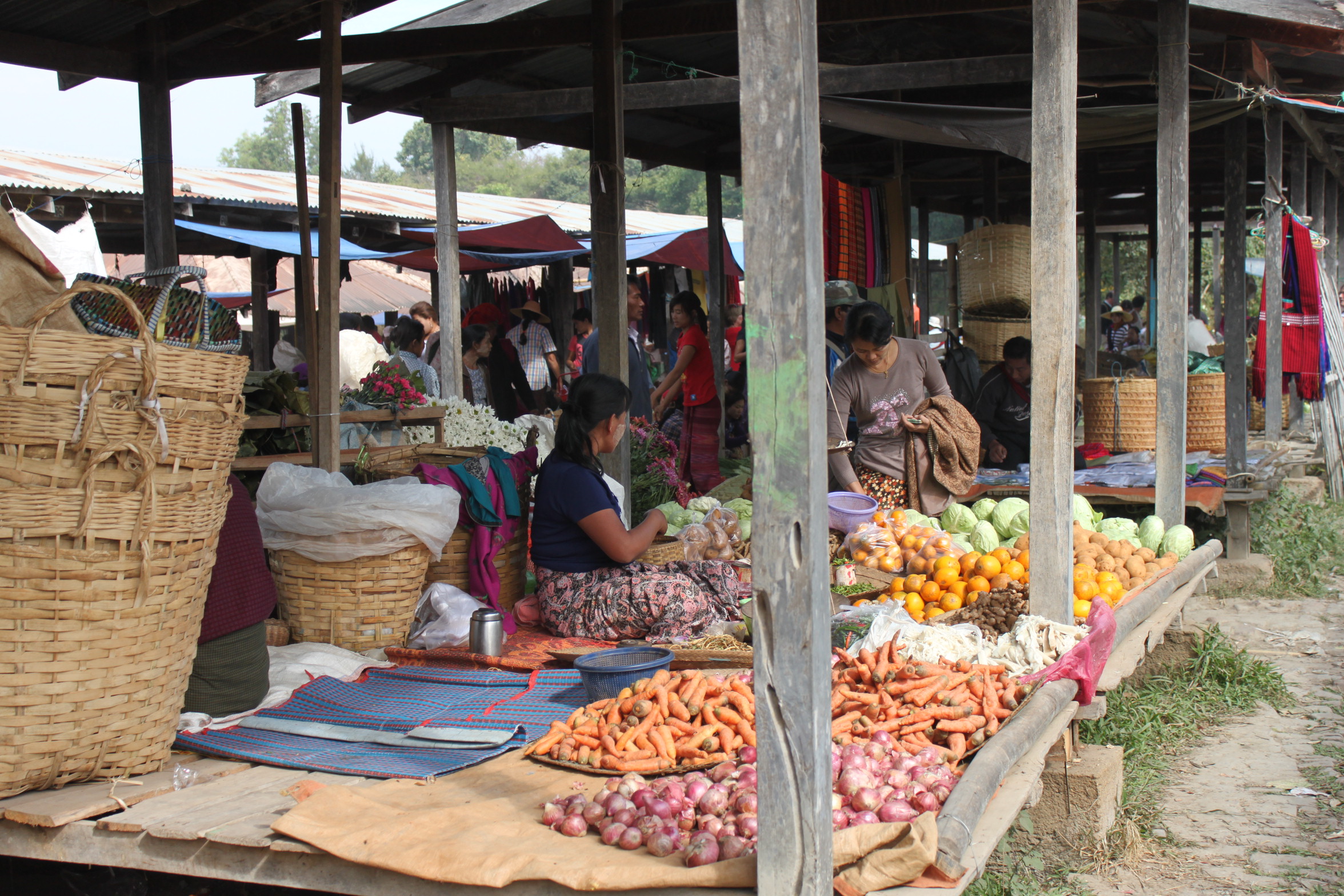
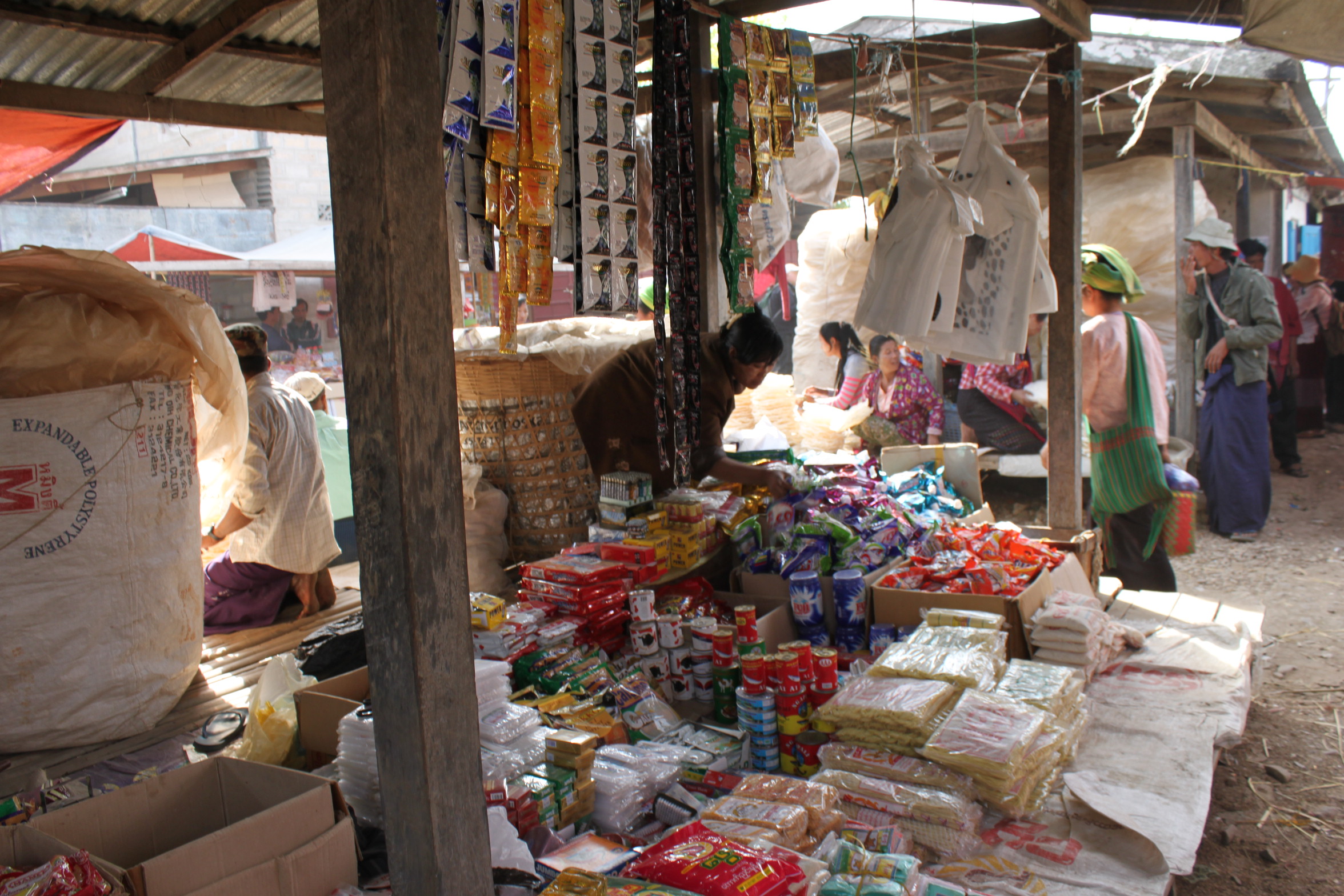
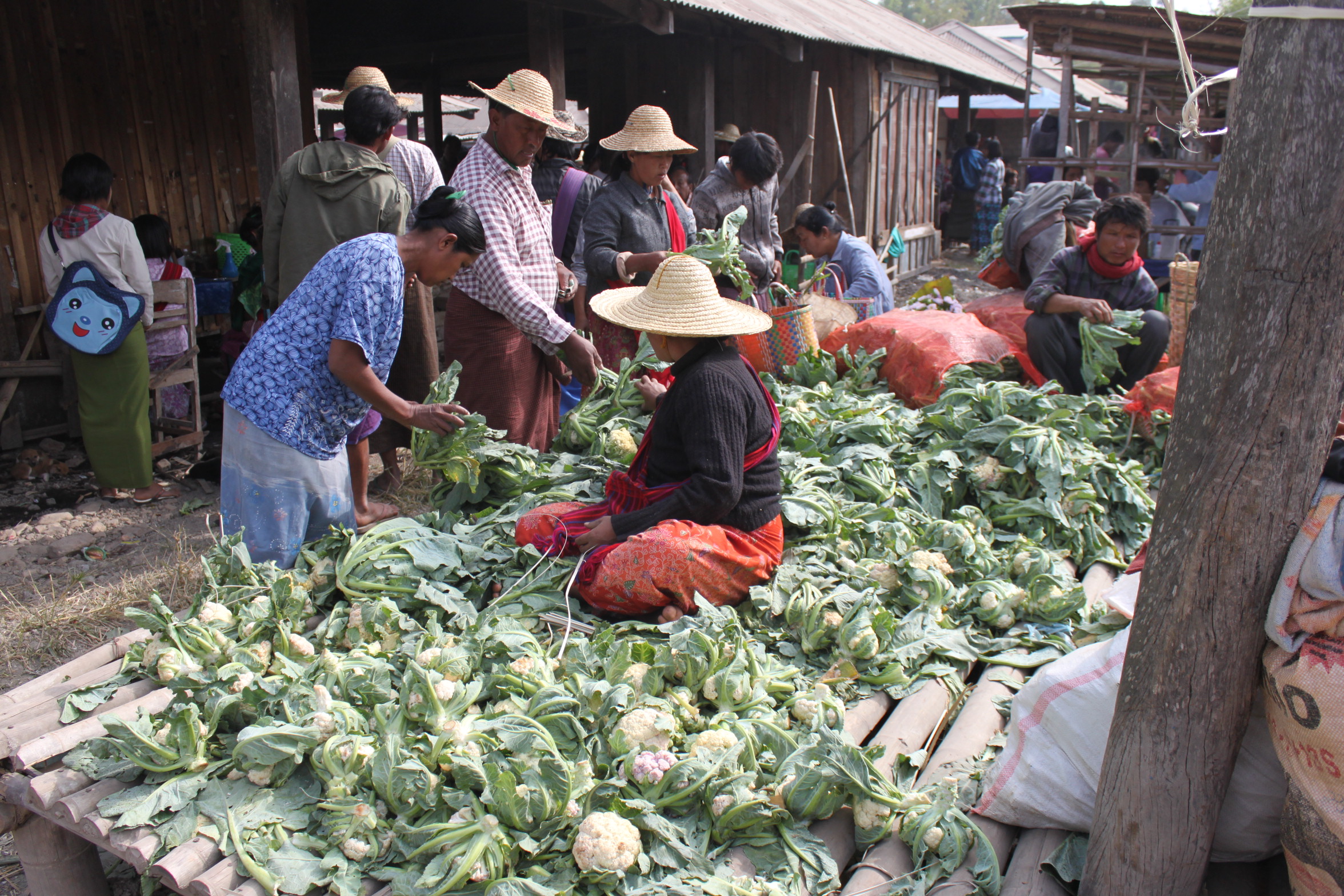
The big markets, such as the ones around Inle Lake, where villagers flock to every few days to buy and sell and socialize, are an experience by themselves. Many villagers reach them by small, motorized boats that are parked, almost piled up, on the lakeshore. The markets are huge and sprawling; I found it easy to get lost in them for a couple of hours, wandering from stall to stall, looking around, and taking photos.

IMG_3270

The vendors aren’t pushy, as they can be in other countries. They sit and chat with their neighbors, arrange and rearrange their products. The women sometimes laugh, sing quietly or cajole their children. There is no rush, no real sense of urgency; things just go by. From early in the morning until the afternoon the market is living.

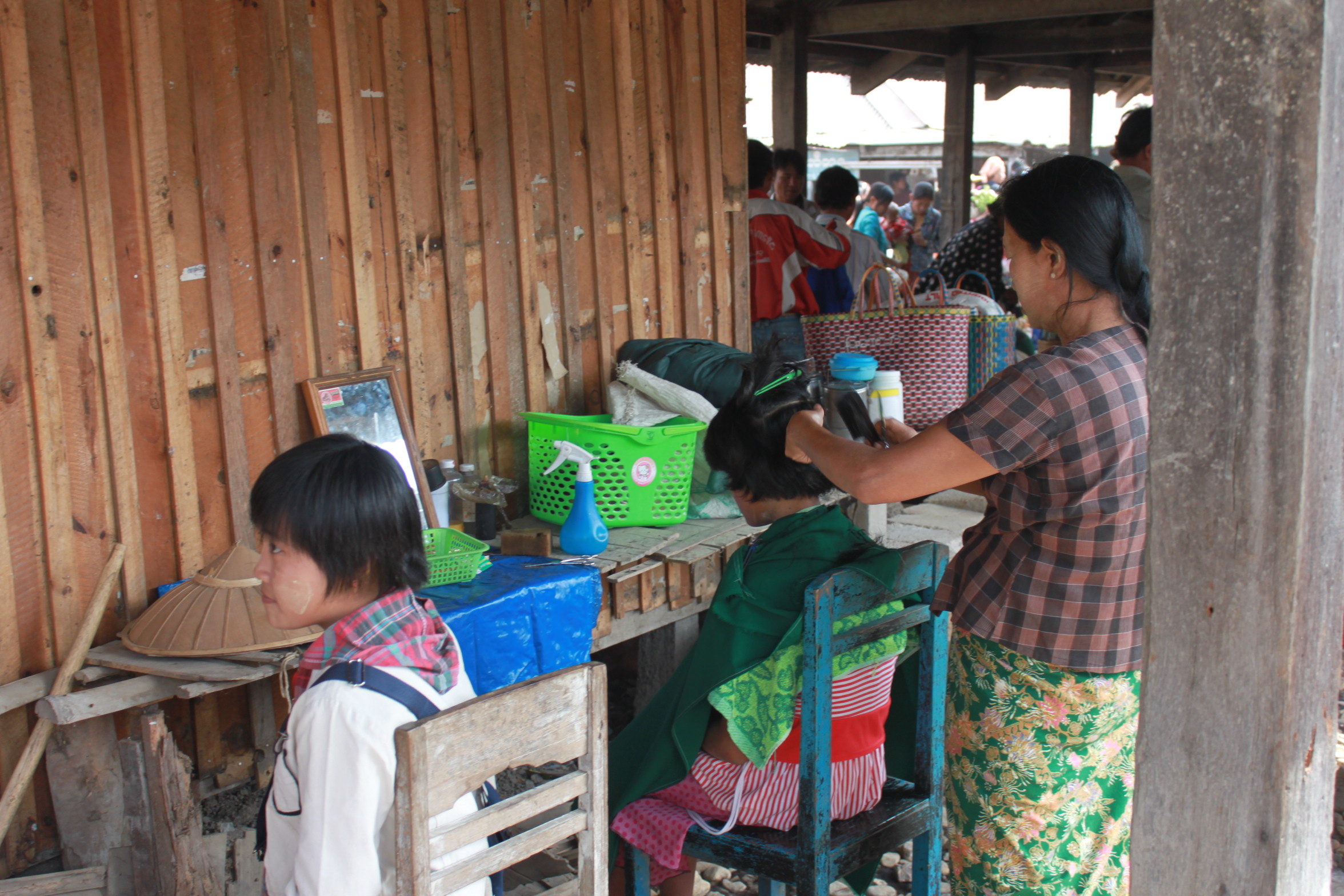
On one side of Nampan market, on the southeast side of Inle Lake, I saw a few hairdressers and barbers doing a brisk trade. The ground was scattered with long black hairs. Normal, I thought, market day is also haircut day.

IMG_3257

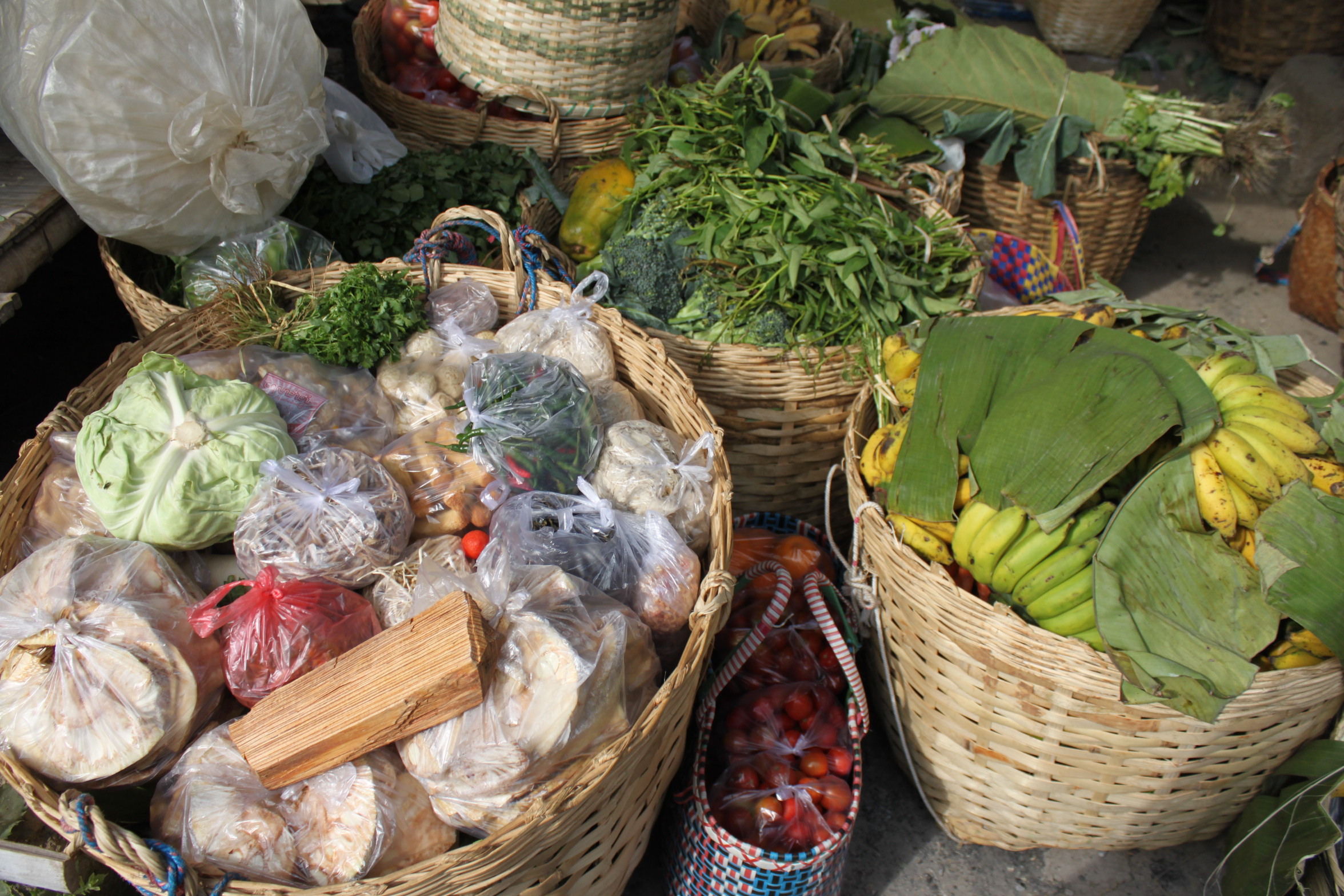
Next to the hairdressing section were rows of buffaloes and carts, surrounded by flies, and then several stalls of beautiful, colorful flowers one should buy as offering to the temples. There were stalls with Chinese beauty products, with all sorts of knives, with medicines of unknown origin and expiry date, with mountains of rice and hills of cauliflowers, with baskets of tomatoes and bunches of herbs. And of course, there were food stalls, where one could sit down, take a rest, slowly slurp a bowl-full of hot noodles while watching puppies, chicks and babies play around the tables.

IMG_3264

IMG_3254

Burmese cooking has an undeserved bad reputation. It’s bland and oily, you may hear from disgruntled travelers. To those complaints I have three simple answers: request chili sauce, don’t eat the oil that sits on top of curries, and get inspired before you travel by reading Naomi Duguid’s fantastic book “Burma, Rivers of flavor” You will find in Burma plenty of tasty curries, all sorts of fresh salads including a slightly bitter tea leaf salad that balances well the richness of the curries, stir-fried vegetables, rice, noodles in soups, noodles without soups.

Alongside the chickpea cakes, the noodle soups are my favorite Burmese dishes. I regularly had them for breakfast, but also for lunch. They were such a satisfying, comforting meal, a much nicer way to start the day than with the ubiquitous fried eggs. I particularly loved the ones I had in Hsipaw, in the cold early mornings before going trekking for the day.

There are plenty of variations, as Duguid’s book illustrates. Some of them, called mohinga, are made with fish-based broth. Some are made with chicken and some with chickpea flour, which gives the soup a silky texture.

IMG_3274

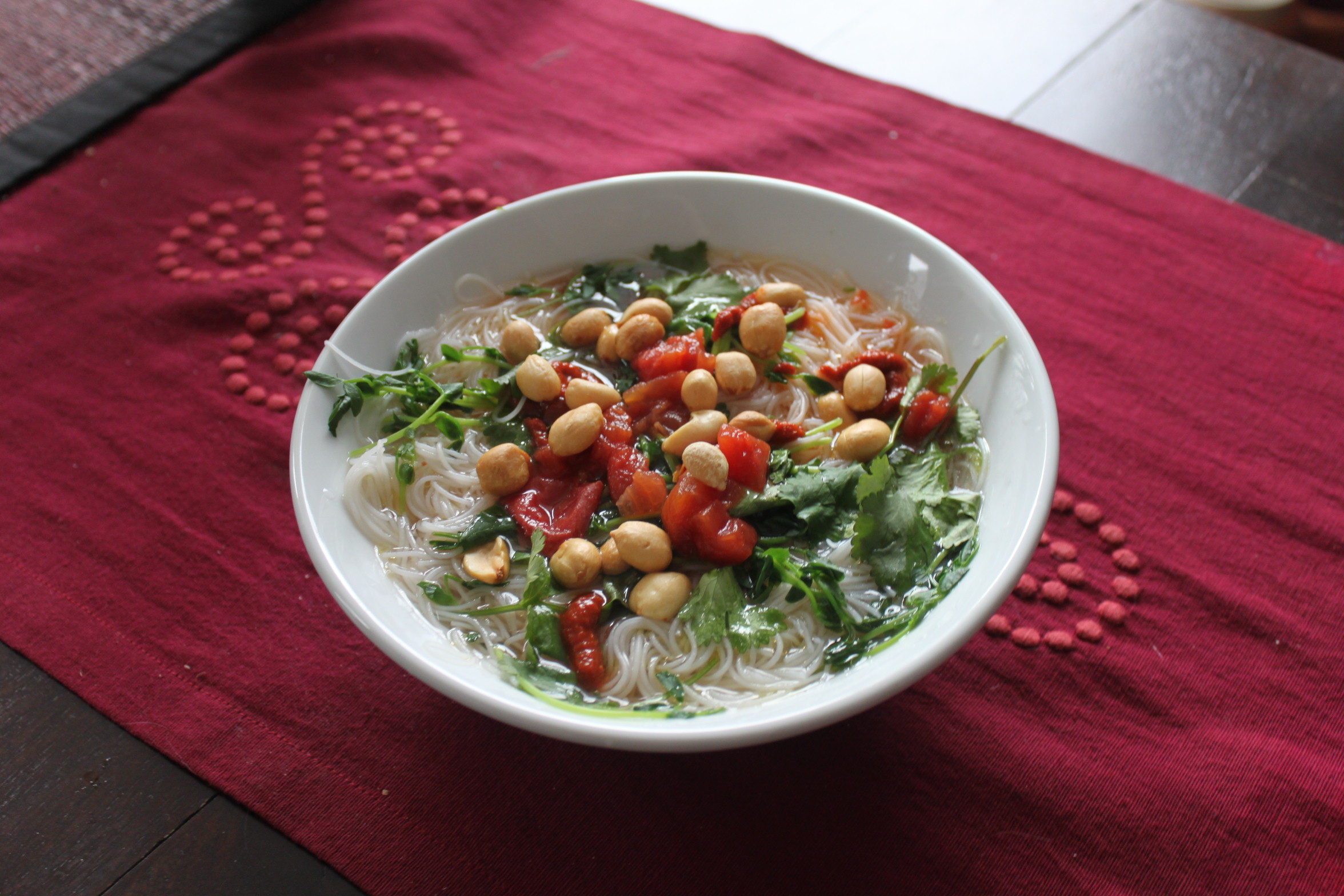
Back at home, I tried to make my own, based on a combination of Duguid’s recipes and the ingredients I could easily find in Canada.

Here’s what I came up with, and what I will eat when nostalgia strikes. Unfortunately though, I haven’t found yet a recipe for the chickpea cakes.

NOSTALGIA NOODLES

(For 1 person)

IMG_3567

Water, just enough to cook the noodles

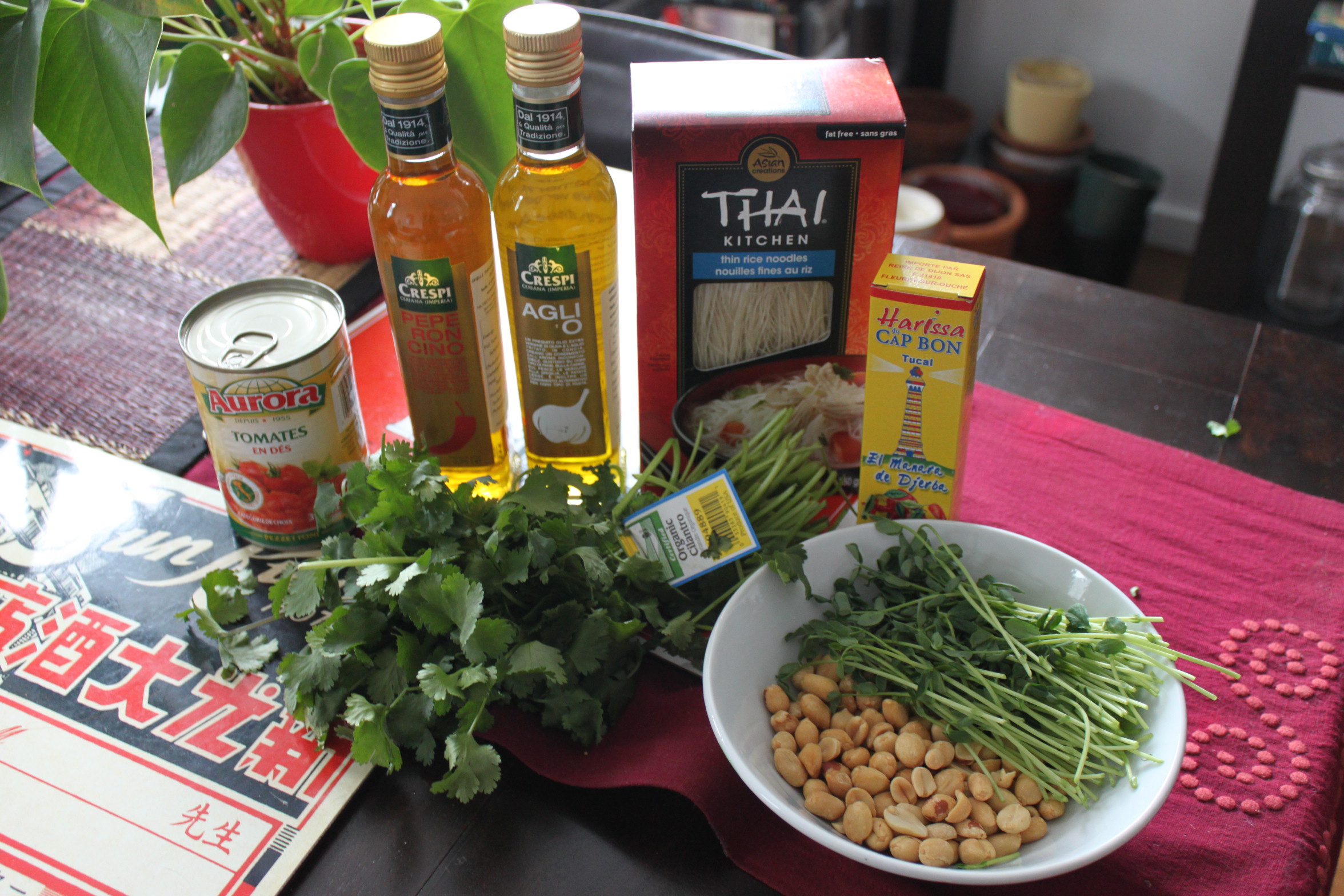
Thin rice noodles, fresh or dry

A few pieces of garlic, chopped

A small piece of fresh ginger, chopped coarsely

Garlic oil

Chili oil

(You could make your own, but if you don’t want to, these oils can be bought already prepared at any better supermarket or Italian grocery)

A teaspoon or two of harissa paste (or any similar thick spicy tomato paste)

A handful of roasted peanuts

A small bunch of pea sprouts

Chopped tomatoes, fresh or from a can, a spoonful or two

Two or three dried chilies

Salt

Ground black pepper

Lots of fresh coriander

Put the water, chopped garlic, ginger and salt in a pot. Cook the noodles in the water according to the instructions in the packet. Add the pea sprouts 15 seconds before they are ready. Drain the noodles and pea sprouts while saving just enough water to have the noodles sitting in a soup without being covered with it. Pour a bit of oil over the noodles, according to taste. Add the rest of the ingredients, according to taste. Mix well. Eat while the soup is very hot.

IMG_3571

If you’re eating it for breakfast, do as in Burma and have it with a cup of black tea or sweet instant coffee. For lunch or dinner, pair the soup with a light lager beer.

The Stones tell Stories in the Bohemian and Beautiful Bale, Istria, Croatia

I’ve always been a fringe dweller, seeking out the sacred and surreal, most at ease in the company of fellow misfits, romantic runaways, free thinkers, drawn to dive bars and hidden away cafés, have lived in seven cities, am best of friends with Scientists and Surgeons, as well as poets and petty crooks.   If I could conjure up an ideal place to live, or just somewhere to visit over and over again, it would involve the sea, the sun, music (preferably Jazz), great food, a foreign language, and all of this shrouded in some kind of mystery, magic, something a lot like the town of Bale in Istria, Croatia.

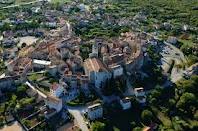
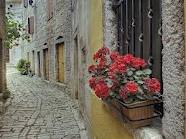
Winding up a stone paved drive, some 140 metres above sea-level, Bale is a small hill town, which is crowned by the baroque St Julian church, only five kilometres from some of the most pristine (and quiet) beaches in Istria, Croatia.

Whenever we travel, my husband usually takes off early in the morning and does his fox-like circumnavigation of where we’re at.  In actual fact, I can thank him for finding many of the markets I have been to, as before I’ve even woken up from my jet-lagged slumber, he would have already scoped out half of his surroundings by bike, boat or foot.  And that’s how we found Kamene Price or  Stone Stories, a groovy treasure of a restaurant/hotel in the middle of this enchanting and bohemian town.

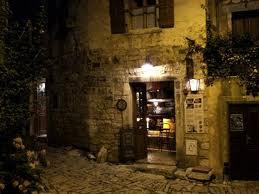
Misha, the chef, an effervescent and unassuming beauty from Dalmatia, poured us a drink and sat down to chat with us against the candle-lit stone wall.  She told us that the owner, a reputable photographer, likes to travel, and through his travels has made a lot of friends from near and far, and well, these friends would often visit him, and so he opened Kamene Price, first to have a place to entertain, but also because he loves to bring like-minded people together, to talk, to eat, to just be. There are poetry readings, theatre nights, and just a few weeks after our trip, Kamene Price also hosts a Jazz festival.  We were tired that night, so headed off early, as we had a long drive back to Italy the next day, yet we promised Misha we would call by before we left.

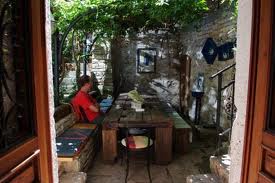
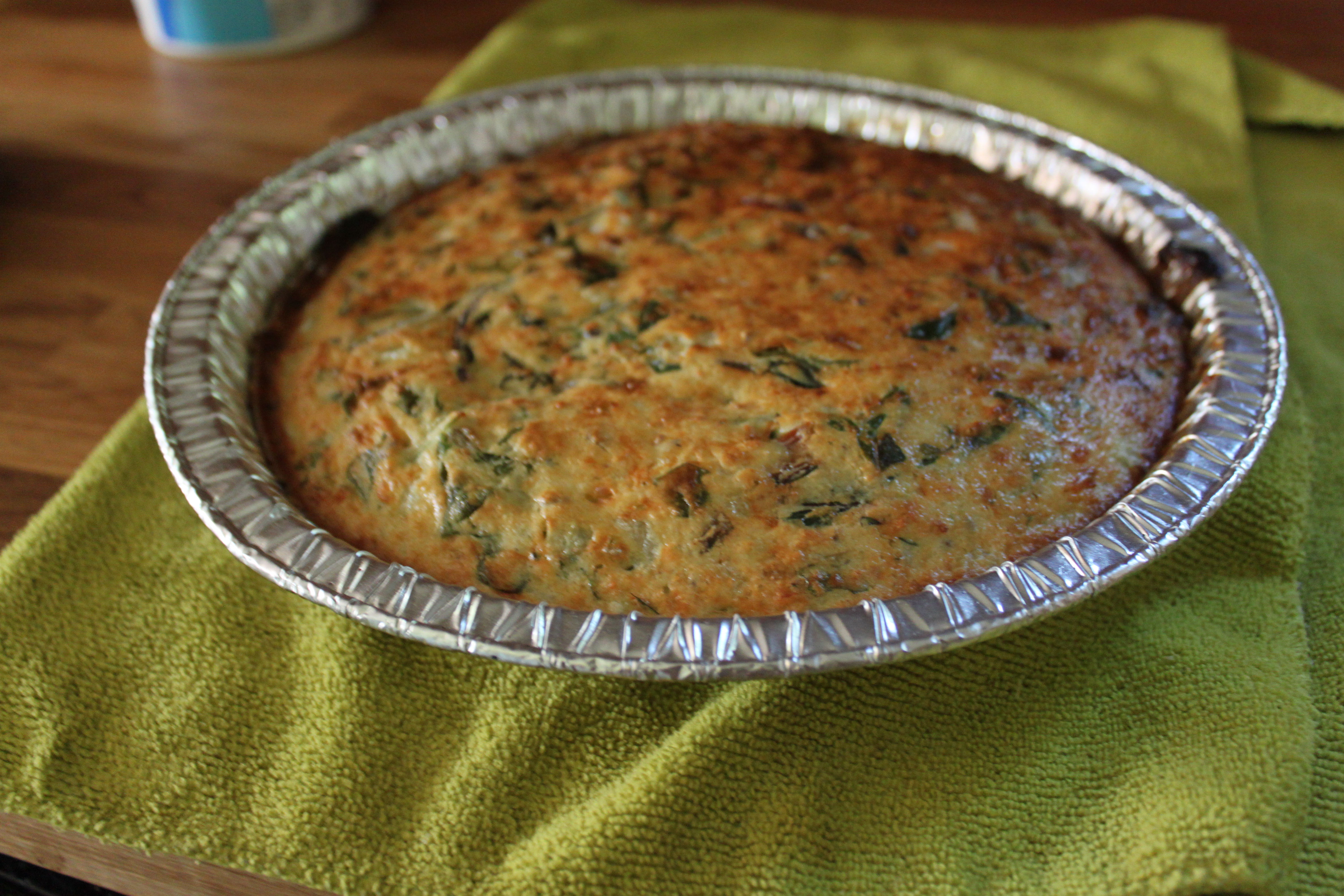
The next day, we stopped in for brunch, and this time in the sun drenched terrace, surrounded by curios, creeping vines and whimsical furniture, I wished for a small moment for  something just like this back home in Montreal. I asked Misha how she decided what to cook for the restaurant. She explained that there was no menu, instead she would head off to the local market each morning, with her favourite cookbook (The Dalmatian Mother’s Cookbook) often in tow, and that would be that.  That day we had a light self-baked swiss chard pie, served with a purée of the most delicately spiced red lentils.  My husband said there couldn’t be a more perfect meal for him. She also cooked up a quick fresh tomato and basil spaghetti for our son, who gladly gobbled it down.  Before we left, we toasted my last glass of rakia in Croatia, this time infused with pungent rose-hip.

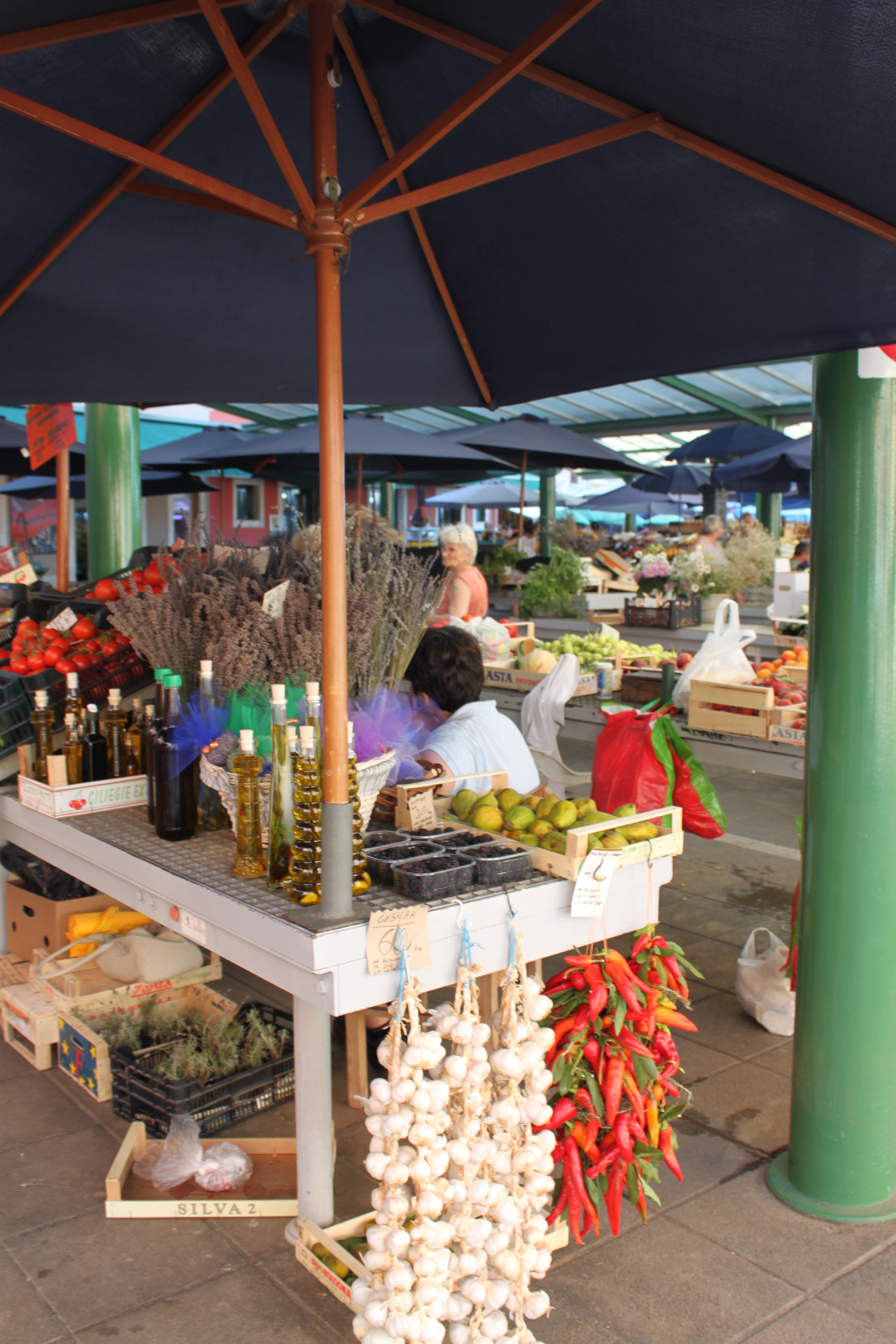
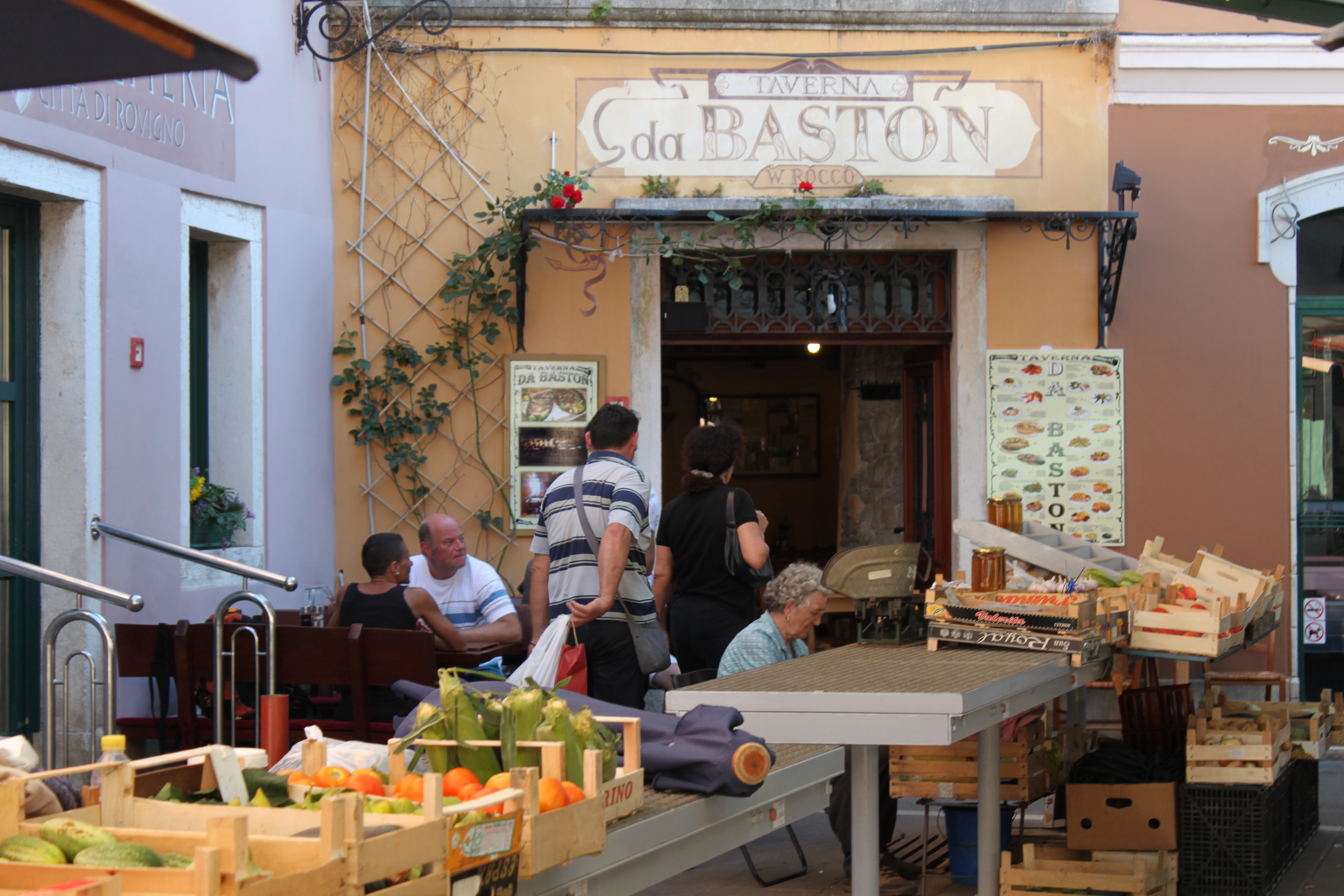
Bale has a small morning market selling fresh fruit and vegetables and fish, yet for a larger market, we ventured into the seaside town of Rovinj in Istria, some seven kilometres away.  Another mesmerizing town (albeit much bigger), the market is situated along the harbour and sports some of the Mediterranean’s finest; olives and olive oils a-plenty, truffle infused products, lavender, peppers, chili, ropes of garlic, the reddest tomatoes, aubergines.

After we said good-bye to Misha, I noticed a sign on the restaurant’s stone wall which wrote of how that legendary free spirit and romantic runaway, Giacomo Casanova had once lived and loved in Bale.   In the opening chapters of his autobiography Histoire de ma Vie (History of my life) he advises his readers that they “will not find all my adventures. I have left out those which would have offended the people who played a part in them …”  yet I bet that in Bale, that if you lean back and put your ear against it’s ancient stone walls, you may just hear a thing or two about that old guy called Casanova.

For further information on Kamene Price, visit their website: http://www.kameneprice.com/

Misha’s swiss chard pie

1 tablespoon olive oil

1 small onion

1 large bunch swiss chard

1 1/2 cups of shredded cheese (e.g. cheddar, parmesan, fontina)

4 eggs

1/2 cup milk

salt and pepper

1 teaspoon of paprika powder

1/2 cup breadcrumbs

1 teaspoon of baking powder

Directions:

  • Pre-heat oven to 375 degrees.
  • Wash and pat dry the swiss chard. Cut off the ends of the stems, and then roughly chop up the chard.
  • Sauté the onion until translucent, and then add the chard, and sauté a few minutes until tender (but not wilted).
  • In a large bowl, whisk in eggs, and then add milk, grated cheese and mix through. Fold in bread crumbs and baking powder.
  • Season with salt and pepper, and the paprika.
  • Pour into a round, lightly oiled baking dish.
  • Bake for up to 45 minutes, or until golden brown and the pie springs back when you touch it.